Best Electrical Slip Rings for High-Performance Applications
2026-08-10
When pushing the boundaries of high-performance machinery, every component matters—especially those that transfer power and data across rotating interfaces. Electrical slip rings are the silent workhorses behind everything from wind turbines to robotic arms, but not all slip rings are built to handle extreme speeds, harsh environments, or uninterrupted signal integrity. If you're engineering a system where failure is not an option, understanding what sets premium slip rings apart is the first step. At MOFLON, decades of slip ring innovation have gone into designs that excel where others falter. Let's dive into what truly defines a high-performance slip ring and how the right choice can elevate your application.
How Slip Rings Keep Advanced Machinery Spinning Without a Hitch
In the world of rotating machinery, continuous power and signal transmission is a silent necessity. Slip rings make this possible by bridging the gap between stationary and rotating components, allowing electricity and data to flow without tangled wires or interrupted motion. Without them, advanced systems from wind turbines to medical scanners would grind to a halt, their intricate movements crippled by broken connections.
A closer look reveals a surprisingly elegant design. Conductive rings and brushes maintain electrical contact as one side spins, transferring power and signals across the rotating interface. Modern versions use fiber brushes or liquid metal to reduce wear and noise, ensuring decades of maintenance-free operation. This quiet innovation keeps everything from radar antennas to packaging machines running smoothly, often unnoticed until the need for a replacement arises.
When slip rings do grab attention, it's usually in extreme environments where failure isn't an option. Offshore wind turbines rely on them to pitch blades against gusting winds, while spacecraft use specialized versions to unfold solar panels without a snag. Through material advances and precision engineering, slip rings have evolved into compact, high-bandwidth devices that handle gigabit data rates and high voltages side by side—keeping the most advanced machinery spinning as if friction didn't exist.
The Hidden Engineering That Makes High-Speed Data and Power Transfer Possible
Every time you plug in a USB cable or connect to Wi-Fi, you're relying on decades of refinement in signal integrity and power delivery. At the physical level, moving bits at gigabit speeds means wrestling with skin effect, dielectric losses, and crosstalk that can corrupt data. Engineers combat this by carefully controlling impedance along the entire path—from the transmitter chip, through PCB traces and connectors, all the way to the receiver. Differential signaling, where two wires carry equal and opposite voltages, is the backbone of modern high-speed interfaces because it rejects common-mode noise and reduces electromagnetic interference without bulky shielding.
But getting clean signals is only half the battle. Power must also flow without compromising that signal quality. High-current paths on a circuit board are laid out as wide planes or thick copper pours to minimize voltage drop and heat buildup, yet these same planes can act as antennas if not properly decoupled. Tiny surface-mount capacitors are strategically placed right next to each chip to supply instantaneous current demands, while ferrite beads isolate noise between analog and digital sections. The stack-up of layers in a multi-layer board isn't arbitrary—ground and power planes are sandwiched together to create intrinsic capacitance that helps filter out spikes at the source.
The connectors themselves hide a world of precision. The exact geometry of each pin, the plating material, and even the plastic housing are tuned to maintain a consistent characteristic impedance as signals transition from cable to device. For power, multiple contacts are often paralleled to share current, and gold-over-nickel plating resists corrosion that would otherwise increase resistance over time. Meanwhile, active circuits inside modern PHY chips continually adjust equalization and pre-emphasis to compensate for the frequency-dependent attenuation of copper, making it possible to send reliable 10Gbps streams over simple twisted-pair cable. It’s a quiet symphony of materials science and electromagnetic theory, all tucked away behind a humble connector.
Choosing the Right Contact Materials for Demanding Environments
Contact degradation in harsh settings rarely follows a predictable path. A connector rated for indoor use can fail within weeks when exposed to airborne sulfides or salt spray, not because of a design flaw, but because the base metal and plating interact with contaminants in ways datasheets seldom capture. The real challenge lies in matching the material system to the exact chemical and mechanical stresses at play—mixing cycles, temperature swings, and even outgassing from nearby polymers can turn a stable oxide layer into a brittle failure point.
Rather than defaulting to gold plating, start by mapping the micro-environment around the contact zone. In high-vibration assemblies, tin's lower cost is often undone by fretting corrosion unless paired with a durable underplate and tight clamping forces. Palladium-nickel alloys, on the other hand, can outperform gold in sulfur-rich atmospheres while keeping insertion forces low. A growing number of mission-critical designs combine a composite coating with selective lubrication, letting engineers fine-tune wear resistance without over-engineering the conductive bulk material.
The cost of getting it wrong isn't just downtime—intermittent opens can induce software glitches that are nearly impossible to reproduce. This is why accelerated life testing should mimic real thermal-humidity cycling plus the specific pollutants of the target installation, not generic salt fog. When the end-use environment is truly unpredictable, building in sacrificial interfaces or hybrid contact structures (such as a hard core with a soft outer layer) often provides a safety net that pure material selection alone cannot offer.
When Standard Rings Aren’t Enough: Custom Solutions for Extreme Conditions
Off-the-shelf sealing rings often fall short when faced with aggressive chemicals, drastic temperature swings, or pressures that push the limits of conventional materials. In these demanding environments, performance isn't just about longevity—it's about safety and operational integrity. That's where custom-engineered rings step in, designed from the ground up to handle the specific stresses your application dishes out. By analyzing the exact media, thermal cycling, and mechanical loads, engineers can select or even develop proprietary elastomers and thermoplastics that outperform generic options by a wide margin.
The secret lies in the balance between material science and geometry. A ring that works perfectly in a static -40°C freezer might crack and fail when subjected to rapid temperature spikes in a chemical reactor. Custom solutions go beyond material selection, incorporating unique profile designs that accommodate thermal expansion, resist extrusion under high pressure, or maintain elasticity after prolonged exposure to oils and solvents. Advanced manufacturing techniques like precision molding and post-curing treatments further enhance reliability, ensuring the ring doesn't just survive but thrives where standards give up.
Moreover, custom doesn't have to mean slow or cost-prohibitive. Modern rapid prototyping and finite element analysis allow manufacturers to iterate quickly, testing virtual models under simulated loads before cutting a single mold. This iterative approach gets a tailored solution into your hands faster than you might expect, often with performance gains that dramatically extend maintenance intervals and reduce downtime. When the standard catalog fails to inspire confidence, it's time to look at a design built exclusively for your challenge.
Maintenance Secrets to Extend the Life of Your Rotary Joints
Many operators overlook the subtle clues that a rotary joint is under stress. A slight temperature spike at the connection point or a faint hiss during rotation can signal early wear. Instead of waiting for obvious leaks, try running a fingertip along the seal area while the system is cool—if you feel uneven texture or tiny pits, the sealing surfaces are degrading faster than expected. Catching these micro-failures lets you replace only the seal ring, not the entire joint.
The media flowing through your joint leaves a hidden signature. Over time, contaminants build up in ways that a simple flush won’t remove. Once a month, disconnect the joint and wipe the inner rotor with a white cloth. If the cloth picks up dark, gummy residue, your filtration is failing upstream. Add a finer mesh filter immediately, and consider a solvent wipe of the rotor before reassembly. This practice alone can double the interval between major overhauls.
Alignment errors during installation are the silent killer of rotary joints. Even a half-degree angular misalignment can force the internal bearing to work at an angle, grinding the seal unevenly. Use a dial indicator on the joint body after mounting, and don’t rely on the piping to hold it straight—fit a small adjustable support bracket that allows micro-adjustments. Retest alignment after the first 50 hours of operation, as thermal expansion often shifts the position just enough to accelerate wear.
Real-World Performance: Slip Rings in Robotics, Wind Turbines, and Medical Devices
In robotics, slip rings unlock full rotational freedom without tangling wires, but their real test comes with repetitive stops and starts. High-cycle applications demand contacts that shrug off wear while maintaining clean signal paths for encoders and power. A slip ring that falters here doesn't just cause downtime—it can throw off a robot's calibration mid-task, leading to scrapped parts or worse.
Wind turbines push slip rings into far harsher territory. Up in the nacelle, they face relentless vibration, temperature swings, and salty mist. Yet they're expected to reliably shunt generator power and pitch control signals for years between maintenance visits. The best designs manage this not by over-engineering, but by matching brush materials and contact forces to the real load profile, essentially shrugging off grime that would cripple a generic unit.
Medical imaging equipment asks for something almost paradoxical: slip rings that pass high-speed data and high voltage with zero chatter, all while rotating smoothly enough to avoid jitter in CT scans. Patients never see these components, but a slipping ring that introduces signal noise could mean a missed diagnosis. That's why in the field, performance isn't about spec sheets—it's about how well the rings hold up after thousands of patient hours without a hiccup.
FAQ
A slip ring capable of handling high-speed data and power relies on precision engineering. Low-contact resistance, minimal electrical noise, and high-quality shielding are essential. Gold-gold contacts often excel because they resist oxidation and provide stable connections. For data, look for designs that minimize crosstalk and maintain impedance control, especially if you're transmitting Ethernet or other high-bandwidth signals. The brush and ring assembly must remain stable at high RPMs without generating excessive heat or wear.
Start by clearly defining your requirements: the number of circuits, voltage, current per circuit, and signal types. Space constraints matter a lot—determine whether a capsule, through-bore, or pancake style fits best. Environmental factors like dust, moisture, and temperature swings will steer you toward sealed or ruggedized models. Don’t overlook rotational speed and lifecycle expectations. Sometimes it’s worth asking a manufacturer for a custom solution if off-the-shelf options fall short.
Absolutely. Many modern slip rings combine power rings and signal rings in one compact assembly. The trick is isolating them properly to prevent electromagnetic interference. You’ll often see separate zones or shielded pathways inside the housing. When mixing high-current power with sensitive analog signals, look for designs that use physical separation, twisted pairs for signal lines, or even fiber optic channels for data if electrical isolation is critical.
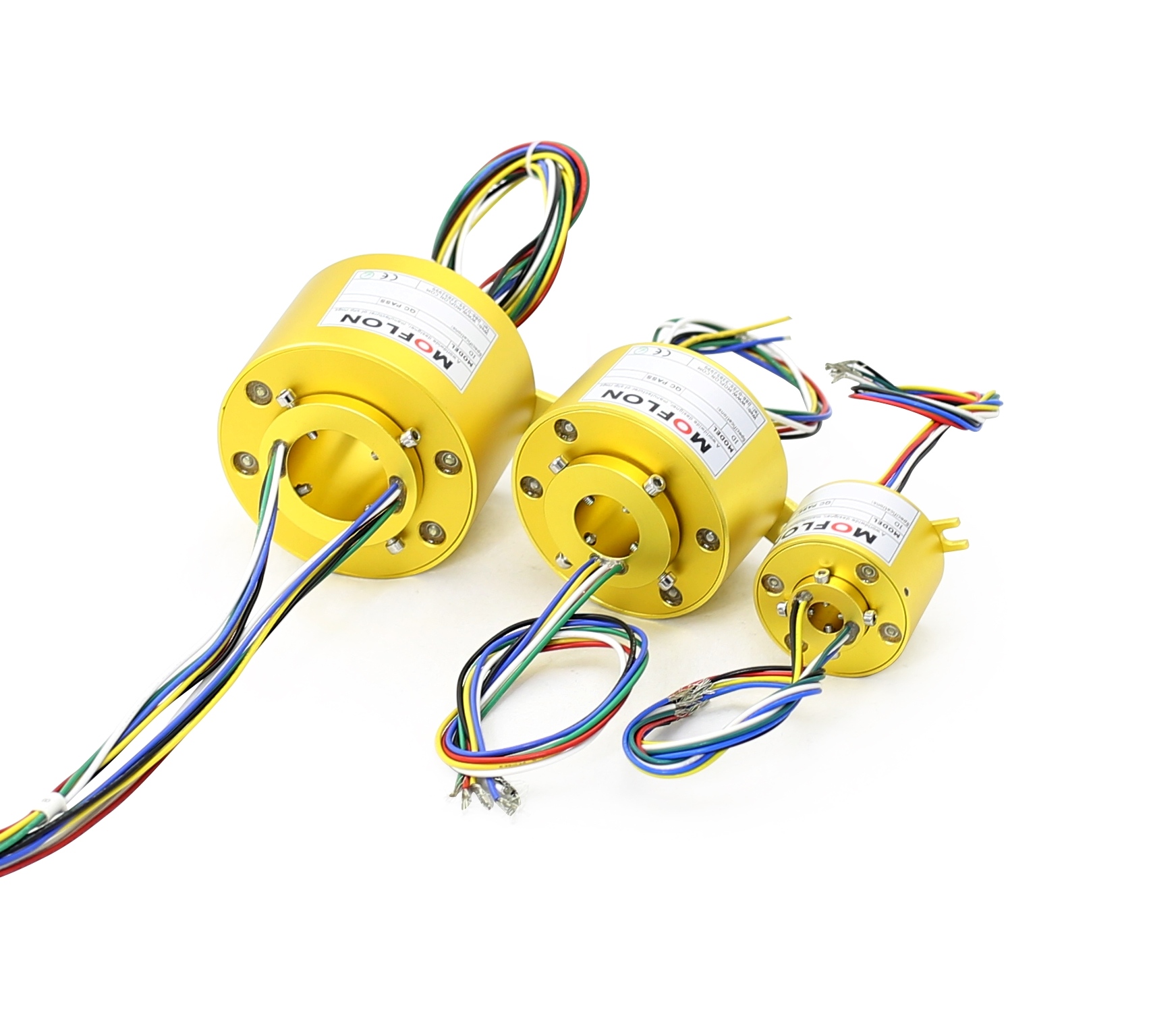
Capsule slip rings are compact, sealed units perfect for space-limited setups like CCTV cameras or small robots. They typically mount on the end of a shaft. Through-bore designs have a hollow center, which lets you route shafts, wiring, or pneumatics straight through—ideal for larger machinery like wind turbines or packaging equipment. Through-bore rings usually handle higher currents and more circuits but take up more space.
Contact material is a huge factor. Gold-on-gold offers excellent corrosion resistance and stable low resistance, making it the go-to for low-current signal and data circuits. Silver graphite or silver alloy contacts handle higher currents well and have self-lubricating properties, but they can oxidize, so they need a good protective environment. For extreme durability in dusty or high-vibration settings, precious metal fiber brushes offer multi-point contact and can last hundreds of millions of revolutions with minimal maintenance.
Yes, many manufacturers build rugged versions for tough conditions. These might include IP67 or IP68 sealing against water and dust, wide temperature tolerance from -40°C to over 100°C, and corrosion-resistant housings. Some use special lubricants that remain stable across temperature extremes. For subsea or washdown environments, stainless steel construction and redundant sealing are common. Always check the ingress protection rating and material certifications to match your specific challenge.
Maintenance depends heavily on the design. Sealed, brushless or precious-metal contact units often run for years with zero upkeep. Traditional graphite or metal brush types may need periodic inspection and brush replacement. When maintenance is needed, it usually involves cleaning the ring surface, checking for wear patterns, and verifying electrical continuity. Some advanced slip rings integrate sensors that monitor brush wear in real time, so you can schedule maintenance only when needed.
Fiber optic rotary joints transmit data using light, so they're immune to electromagnetic interference and can handle extremely high bandwidths over long distances. They’re ideal when you need to pass gigabit Ethernet or high-def video without any signal degradation. Electrical slip rings, in contrast, can also carry power, which fiber can't. Often, a hybrid solution—combining electrical rings for power and a fiber optic channel for data—gives you the best of both worlds. The choice really comes down to whether your application requires power transmission or can make do with data-only rotation.
Conclusion
The heartbeat of advanced machinery often lies in a component that rarely gets the spotlight: the slip ring. From robotic arms to wind turbines, these rotary joints ensure power and data flow seamlessly across spinning interfaces. Without them, continuous rotation would be impossible—cables would twist, signals would drop, and downtime would skyrocket. But what separates an ordinary slip ring from one built for high-performance applications? It starts with what’s hidden inside: the engineering that enables high-speed signal transfer without crosstalk or degradation, often through precisely aligned fiber brushes and layered shielding. Contact materials are just as critical; gold-on-gold pairs excel in low-current data circuits, while silver graphite handles high currents in dirty, humid, or corrosive environments. The choice isn’t generic—it’s a deliberate match between the ring’s environment and its mission, whether that’s on a factory floor or an offshore turbine.
Even the best-designed standard rings can fall short when extremes test the limits. That’s where custom engineering steps in: hybrid models that blend power, fluid, and fiber-optic channels into a single compact unit, or ruggedized housings that laugh at explosive atmospheres and salt spray. Longevity, however, hinges on practical maintenance—periodic inspection of brush wear, controlled lubrication to fend off debris, and monitoring electrical noise as an early warning sign. These practices turn a reactive replacement cycle into a proactive strategy. The proof surfaces in real-world settings: surgical robots demanding micron-level precision and zero EMI, wind turbines that spin relentlessly in subzero gales while transmitting gigawatt-hours of data, and CT scanners where a single flicker in a signal line can compromise an image. In each case, the slip ring isn’t just a connector—it’s the unsung enabler of performance that quietly sustains our most ambitious technologies.
Contact Us
Contact Person: Xiangpin Li
Email: [email protected]
Tel/WhatsApp: 86 186 1706 8578
Website: https://www.moflon.com