Cleanroom HVAC System Company Reveals Essential Tips for Contamination Control
2026-08-28
Most contamination control failures don't start with a torn glove or a faulty pass-through—they start in the HVAC system, where small changes in airflow or pressure can spiral into major deviations. In this blog, the cleanroom specialists at GENO Pharmatech pull from real project experience to share the essential tips they use to keep cleanrooms stable, compliant, and audit-ready. If you're responsible for a controlled environment, the next few minutes could save you from a costly surprise.
Airflow Design Pitfalls That Invite Particle Buildup
Most particle buildup problems in supposedly clean airflow systems can be traced back to one thing: poor velocity control at the design stage. When duct sizes are chosen without accounting for actual filter loading, air speed drops below the transport threshold in quiet corners. That's where fine powder settles and forms a stubborn layer. The worst offenders are return vents placed behind large machines or inside recessed alcoves—air simply never reaches them with enough force to carry debris away.
Another overlooked flaw is the use of long, straight return ducts with no cleanout access. While they look efficient on paper, they act as settling chambers. Particles that survive the first few meters gradually fall out of suspension as the air slows near walls. Adding to the problem, many designs put dampers in locations that create sharp pressure drops, causing sudden eddies that spit particles back into the work zone rather than guiding them into filtration.
Recirculation zones are equally likely to blame. When supply diffusers are spaced too far apart or aimed incorrectly, opposing air streams collide and form stagnant pockets. These areas may feel draft-free, but they quietly accumulate dust on ledges, pipes, and overhead beams. Without smoke studies during commissioning, these dead spots stay hidden until product defects or repeated cleaning failures make them obvious.
Pressure Cascade Checks Most Facilities Skip
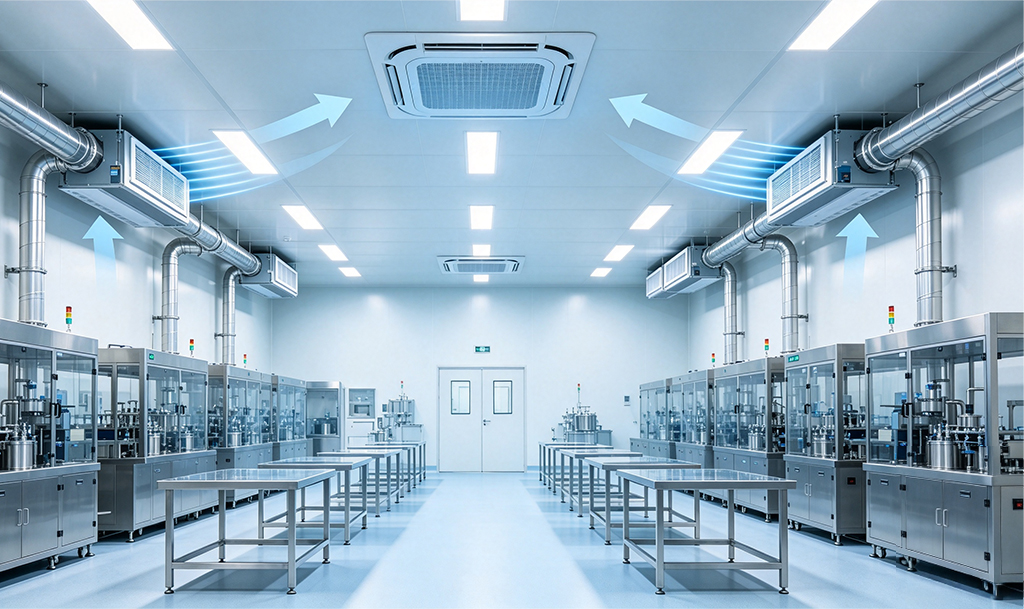
Most facilities glance at static pressure readings and call it a day. The gauges show a steady negative in the corridor, so everyone assumes the cascade is holding. But static numbers lie. Open a single door, cycle a fan, or let a filter load up, and the actual pressure relationships can flip without anyone noticing. The checks that matter happen during transitions—when doors swing, when air handlers ramp down, when demand shifts—and those are exactly the moments that never get measured.
Skipped checks include the obvious ones: running a simultaneous door-open test on an airlock, watching recovery time after a power blip, and rechecking differentials with filters at mid-life rather than brand new. Facilities also rarely map the cascade under normal movement patterns. A nurse pushing a cart through a double-door entry, or a forklift passing through a dock seal, creates a pressure pulse that can pull air backward for seconds. Those seconds are enough to move contaminants into supposedly clean zones.
The result is a false sense of control. The static snapshot passes audit, but the live building fails its own safety intent. Instead of trusting fixed setpoints, maintenance teams should record pressure swings during routine operations and adjust dampers, door closers, or fan speed controls to hold the cascade even when things move. That kind of check takes extra time and coordination, which is why it gets skipped—but it is the only way to know if the pressure cascade actually does its job.
Filter Testing Beyond the Annual Certification
Relying solely on an annual certification leaves long stretches where filter performance can drift unnoticed. Process changes, unusual particle loads, or repeated sterilization cycles can alter membrane structure well before the next scheduled test. Spot checks after maintenance or batch changeovers catch these shifts early, giving operators a clearer picture of actual filter condition in daily use.
A practical approach is to pair routine pressure differential readings with periodic integrity tests tied to production milestones rather than calendar dates. For example, testing after every ten filtration batches or immediately following a suspected pressure spike creates a more responsive safety net. This method reduces the risk of releasing product filtered through a compromised membrane while avoiding the downtime of unnecessary full re-qualifications.
Facilities that adopt this layered strategy often build a running log of filter behavior under real operating conditions. Trends in flow decay or bubble point values become early indicators, so replacements happen based on evidence instead of a fixed schedule. Over time, that history supports extending or tightening test intervals with confidence, turning filter testing from a compliance checkbox into a genuine process control tool.
Humidity Swings and Their Hidden Microbial Impact
Indoor humidity rarely sits still. It drifts with the weather, spikes after a shower, or plunges when the heater kicks on. Each swing creates a brief but potent window for microbial communities to reshuffle. Mold spores that lay dormant in drywall can germinate within 48 hours of a humidity jump above 65%. Meanwhile, a sudden drop below 30% doesn’t kill bacteria—it just forces many species into a hardier, spore-like state that waits for the next moist breath of air.
The real trouble is that we rarely notice these shifts. A bathroom that feels dry by morning may have hosted a thriving biofilm overnight. Dust mites, which feed on shed skin cells, need only a few hours of elevated humidity to double their metabolic activity. And because most homes don’t log humidity data, these micro-events go unseen until a musty smell or allergy flare-up forces attention. The microbes, meanwhile, treat each swing as a rhythm to exploit—waking, feeding, and releasing spores in sync with your daily routines.
What makes this hidden impact harder to manage is that it’s not about average humidity. A room that averages 50% can still spike to 75% during a single boiling pot of pasta or a long shower. It’s the amplitude, not the mean, that drives microbial success. Builders and homeowners often chase a single ideal number, but the more useful target is stability—keeping fluctuations within a 10% band. Without that, you’re not just managing moisture; you’re unknowingly scheduling microbial boom-and-bust cycles that leave behind allergens, mycotoxins, and a lingering biological residue.
Real-Time Monitoring Without Data Overload
Live data streams often bury the signal under an avalanche of metrics, alerts, and logs. The key is not to collect everything but to filter for what actually changes decisions in the next five minutes. A well-designed monitoring view shows only deviations that matter, keeping the noise floor low enough that a genuine anomaly stands out immediately.
Instead of pushing every heartbeat to a dashboard, smart systems sample at adaptive rates and summarize at the edge. For example, a temperature sensor in a warehouse doesn't need millisecond updates if the thermal inertia of the room smooths out rapid fluctuations. By aggregating into rolling windows and comparing against learned baselines, you preserve real-time awareness without drowning operators in repetitive data.
The real test is whether the person on call can glance at the screen and know if something is wrong in under ten seconds. That means using visual hierarchy, suppressing redundant alarms, and only escalating when a threshold crosses a sustained pattern—not a single spike. Real-time monitoring then becomes a quiet guardian rather than a firehose of information.
Operator Habits That Defeat Even the Best HVAC Design
A perfectly engineered HVAC system can still fall short when the people running it develop habits that work against its design. One of the most common examples is constantly fiddling with the thermostat. While it may feel like a quick fix for comfort, frequent setpoint changes force the equipment into short cycling, where compressors and fans start and stop far more often than intended. This not only wastes energy but also accelerates wear on critical components, gradually eroding the efficiency gains that the original design promised.
Another destructive habit is neglecting routine maintenance tasks like changing filters or cleaning coils. Operators often assume that because the system is "new" or "high-efficiency," it can run for longer periods without attention. In reality, a clogged filter restricts airflow, making the blower work harder and causing the system to operate outside its designed parameters. Over time, this leads to reduced capacity, uneven temperatures, and even premature failure of motors or compressors—all of which could have been avoided with a simple monthly check.
Manual overrides are perhaps the sneakiest problem. Well-designed HVAC systems rely on sensors and automated schedules to balance comfort and energy use. But when operators habitually switch the system to "manual" mode, disable sensors, or open windows while the AC is running, they throw that careful logic out the window. The system ends up fighting itself—cooling a space that is also being heated by outside air, or running full blast in an empty room. These habits don't just defeat the design; they turn a smart system into a dumb one, and the energy bills prove it.
FAQ
We don't start with the HEPA filters. We start with the room's pressure envelope. Nine times out of ten, there's a door sweep that's worn, a pass-through that's not sealing, or a cable penetration that was never properly sealed. Those small leaks pull in dirty air from adjacent spaces and wreck the particle count.
Filters matter, but we see more contamination from poor condensate management and dirty cooling coils. If the coil gets a biofilm layer, the air passing over it can pick up microbes even after perfect filtration. We recommend quarterly coil cleaning and ensuring the drain pan slopes at least 1/8 inch per foot.
At minimum every two years, but also after any major renovation or change in process. We've seen facilities that change their product line and suddenly the airflow patterns don't match the new equipment layout. A full rebalance with smoke studies can reveal dead zones that no filter change will fix.
Install door alarms that log open events, not just beep. People tend to prop doors open during shift changes or material moves. When you see a log showing a door open for 12 minutes at 2 AM, you realize it's a behavior issue, not an HVAC issue. Also, check the door closer tension regularly—it drifts.
Humidity below 40% RH can cause static electricity to hold particles on surfaces, so when someone walks by, those particles become airborne. Above 60% RH, you risk microbial growth on walls and filters. We target 45-55% RH with tight tolerance. But the real trick is controlling dew point at the cooling coil, not just room RH.
Real-time particle counters integrated with building automation are useful, but only if you act on the data. We've seen facilities collect terabytes and never look at trends. Another useful thing is UV-C lamps in the drain pan area to keep coils clean—just make sure they're sized and positioned correctly, not just tossed in.
People often replace the AHU but keep the old ductwork without inspecting joints and internal insulation. Old fiberglass insulation can shed particles or absorb moisture. If you're upgrading, do a full duct leakage test and consider replacing lined duct with double-wall construction or externally insulated duct.
Conclusion
Cleanroom HVAC systems rarely fail because of the equipment itself; the real culprits are often subtle design missteps and skipped routine checks. Many facilities unknowingly create particle traps through poor airflow patterns—dead zones, improper return air placement, or supply diffusers that fight each other. Pressure cascades are another weak point. They get set during commissioning, then nobody verifies them until something goes wrong. A door left open or a damaged sweep can quietly flatten the pressure differential between zones, allowing contamination to drift into critical areas. Filter testing is usually treated as a yearly box to tick, but real-world conditions demand more. Loading patterns, vibration, and even minor housing leaks can compromise filter integrity long before the next certification date.
Humidity swings deserve more attention than they typically receive. When relative humidity drifts above or below the narrow band, it does not just affect comfort—it creates ideal conditions for microbial growth on surfaces and within ductwork. Real-time monitoring can help, but only if it is filtered intelligently. Dumping hundreds of raw data points on operators leads to alarm fatigue and missed signals. Instead, facilities should focus on a handful of meaningful trends: pressure differentials, particle counts in critical zones, and humidity stability. Finally, even the best-designed HVAC system cannot overcome poor operator habits. Rapid movements, improper gowning, blocking return grilles with equipment, or propping doors open will undermine every engineering safeguard. Contamination control is not a design problem to solve once; it is a continuous interplay between the HVAC system, the building, and the people inside.
Contact Us
Contact Person: Amy Yang
Email: [email protected]
Tel/WhatsApp: 008619330882686
Website: https://www.genopharmatech.com/