Dry Type Transformer Manufacturer Delivers Safe and Efficient Power Solutions
2026-08-10
When power demands grow and safety can’t be compromised, finding a dry type transformer manufacturer that truly delivers isn’t just a choice—it’s a necessity. At the forefront of reliable energy solutions, Deepwill is quietly redefining what efficient and worry‑free power looks like for modern industries. With fire resistance, low maintenance, and a design built for real‑world challenges, their transformers are setting a new standard—one that engineers and project managers are starting to take serious note of. But what makes these solutions stand out in a crowded market, and why are they becoming the first call for so many? Let’s open the box.
Advanced Manufacturing for Reliable Dry Type Transformers
Precision winding techniques and automated layering processes form the backbone of modern dry type transformer production. Rather than relying on traditional manual methods, manufacturers now deploy computer-controlled winding machines that maintain exact tension and alignment, eliminating air gaps and hot spots that often compromise insulation integrity. This attention to consistency during coil formation directly translates to enhanced thermal stability and prolonged operational life, even under fluctuating load conditions.
Materials science plays an equally critical role in crafting resilient units. Advanced epoxy resins and high-grade core steels are selected not just for their electrical properties, but for their ability to withstand harsh environmental stressors—moisture, chemical exposure, and mechanical vibration. Casting under vacuum ensures that encapsulation is void-free, which substantially reduces partial discharge risks. The result is a transformer that performs reliably in demanding settings from offshore wind farms to underground substations without the maintenance burden of liquid-filled alternatives.
Quality validation goes beyond standard electrical tests. Each unit undergoes rigorous thermal imaging assessments, impulse voltage trials, and accelerated aging simulations to confirm that manufacturing tolerances meet field expectations. Digital twin technology increasingly allows engineers to replicate real-world operating scenarios and catch potential weaknesses before units ship. This blend of robust production discipline and predictive testing produces dry type transformers that users trust for decades of trouble-free service.
How Core and Coil Design Minimizes Energy Loss
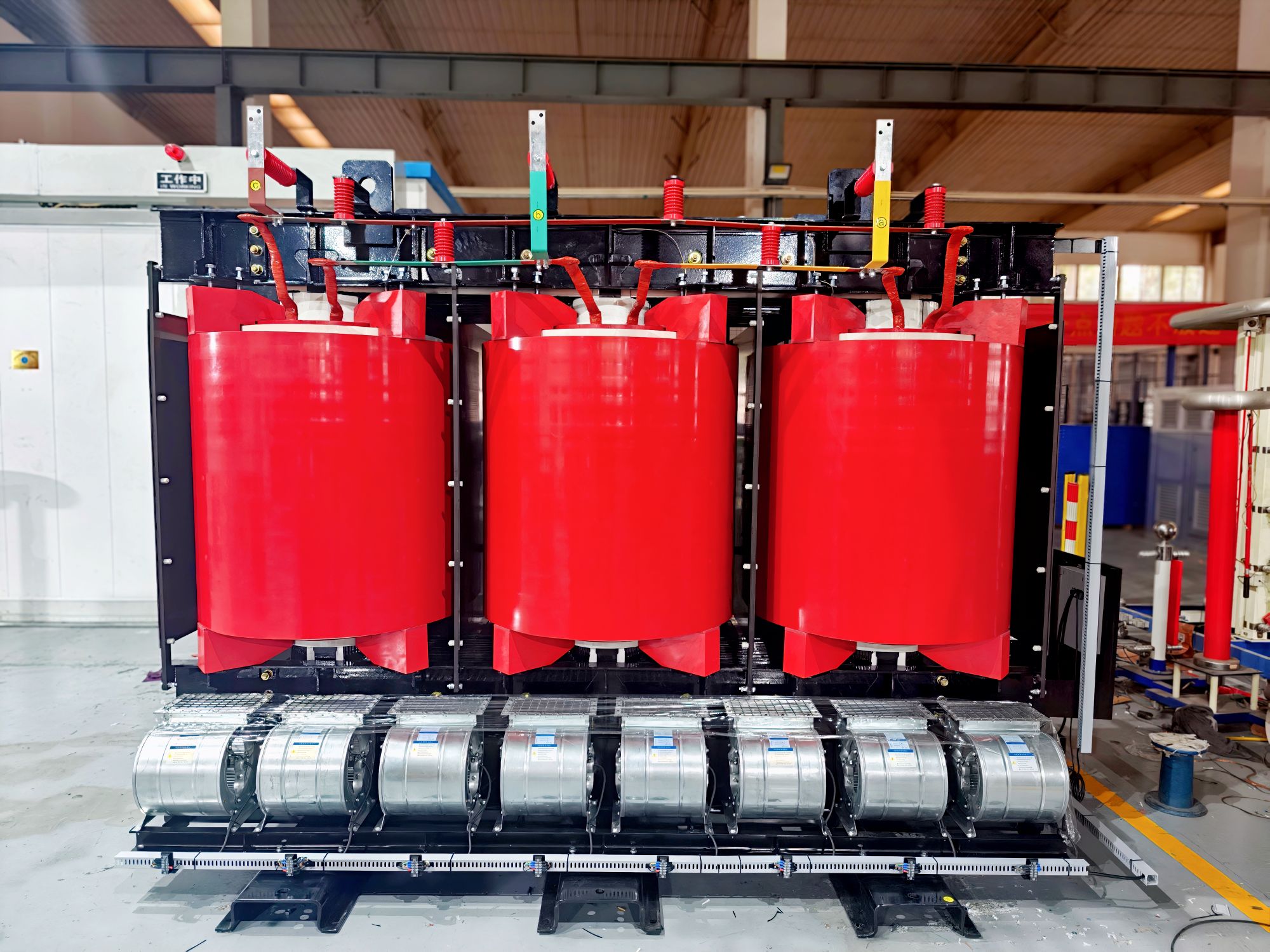
The choice of core material sets the foundation for energy efficiency. High-permeability silicon steel, often grain-oriented, drastically reduces hysteresis loss by allowing easy magnetization reversal. For even greater savings, amorphous metal cores cut eddy-current losses to a fraction of traditional steel—their disordered atomic structure naturally resists current flow, keeping waste heat minimal even at high frequencies.
Coil design tackles resistive losses head-on. Litz wire, comprised of many thin insulated strands, is woven to equalize current distribution and beat skin-effect losses that would otherwise concentrate current on the conductor’s surface. Interleaved winding techniques further curb proximity-effect losses by managing magnetic fields between adjacent turns, ensuring that every strand carries its fair share without excessive AC resistance.
Beyond materials, the physical arrangement makes a tangible difference. Shortening the magnetic path length through compact core geometries reduces the volume of material cycled in and out of saturation, directly trimming core loss. Strategically placed air gaps fine-tune inductance and prevent saturation spikes, while integrated cooling channels whisk heat out of tightly packed coils, maintaining resistance low and reliability high without adding bulk.
Safety Features That Exceed Industry Standards
When you step into a vehicle built with safety as its cornerstone, you immediately notice the thoughtfulness behind every detail. Our approach goes far beyond meeting regulatory benchmarks—we actively anticipate real-world scenarios that most manufacturers overlook. For instance, the reinforced roof structure isn't just designed to pass a static crush test; it's engineered to maintain integrity during dynamic rollover events, a distinction that often makes the difference when milliseconds count. The placement of airbags also reflects this philosophy. Instead of simply increasing their number, we've refined their deployment algorithms to account for occupant position, crash severity, and even the angle of impact, ensuring that protection is precisely tailored to each situation rather than following a one-size-fits-all logic.
One area where we've pushed boundaries is in the integration of active and passive safety systems. Most vehicles treat these as separate domains, but we've created a seamless network where sensors continuously share information. The pre-collision system doesn't just warn the driver or autonomously brake; it also prepares the seatbelt pretensioners, adjusts the suspension to optimize crash compatibility, and even initiates a subtle shift in the headrest position to reduce whiplash risk—all within a fraction of a second. This level of coordination means that the car is essentially bracing itself and its occupants before an impact occurs, a capability that redefines what it means to be proactive. And we've tested these systems not only in controlled laboratories but also in challenging conditions like gravel roads, heavy rain, and nighttime scenarios, where many safety technologies tend to underperform.
We also recognize that true safety extends to the well-being of everyone outside the vehicle. Our latest pedestrian and cyclist detection system uses a dual-camera and radar setup with machine-learning algorithms that can identify vulnerable road users in low-light or partially obscured situations. Unlike standard systems that may only brake if a collision is imminent, ours can gently nudge the steering to avoid a person while keeping the car stable, and it's programmed to prioritize the least harmful outcome when a collision is unavoidable. The hood design, too, has been reimagined with hidden deformable structures that cushion impact forces on a pedestrian's head and torso, going above the legal minimum requirements. Every such choice stems from a belief that exceptional safety isn't about chasing scores on a test—it's about genuinely protecting lives in the messy, unpredictable world outside.
Custom Solutions for Diverse Power Requirements
Every project brings its own set of power challenges, and off-the-shelf solutions rarely fit the bill. Our approach starts with understanding the specific voltage, load, and environmental conditions your equipment will face. Whether you're operating in a remote field station with unstable grid access or integrating sensitive medical devices that demand ultra-clean output, we tailor the architecture from the ground up. This means selecting the right topology, cooling method, and enclosure to match real-world demands rather than forcing a generic box into a complex situation.
Beyond basic electrical parameters, diverse requirements often stem from industry standards and physical constraints. A marine application might need corrosion resistance and shock tolerance, while a telecom site could prioritize high efficiency and compact form factor. We’ve designed units that handle wide-input fluctuations for solar-powered systems, as well as low-noise models for laboratory environments. By involving our engineering team early, you avoid the compromises of adapted consumer-grade hardware and get a power supply that feels like it was built for your exact use case—because it was.
The result is more than just a specification sheet; it’s a reliable power core that lets you focus on your primary technology. We’ve seen how the right custom solution eliminates recurring failures, reduces on-site troubleshooting, and even lowers total cost of ownership over time. From prototype to production, the process is collaborative, with prototypes tested under your actual operating profiles. When power requirements refuse to fit a standard mold, a purpose-built design turns a headache into a seamless part of your system’s success.
Real-World Performance in Critical Applications
When reliability isn't just a preference but a mandate, real-world performance reveals its true colors. In environments like emergency response systems or financial trading platforms, every microsecond counts. The difference between success and failure often comes down to how a system behaves under unpredictable loads, not just in a controlled lab. This is where theoretical benchmarks meet the messy reality of fluctuating network conditions, hardware variability, and concurrent processes that refuse to wait their turn.
Take, for example, a medical monitoring device that must process sensor data in real time to alert staff about a patient’s deteriorating condition. If the underlying software introduces latency or memory contention, the result isn’t just a sluggish interface—it can be life-threatening. Engineers working on these systems learn to trust profiling data gathered from actual deployments more than any synthetic test. They optimize for the worst-case scenario, often sacrificing raw throughput to achieve consistent response times that users can bet their safety on.
The same principle applies at scale. A video conferencing service used by millions may have passed stress tests in development, but once released, it encounters an endless variety of device setups, network topologies, and usage patterns. The only way to guarantee performance is to instrument the product heavily, collect telemetry from the field, and iteratively refine. It’s not about chasing perfection on paper; it’s about building a system that degrades gracefully and keeps core functions intact when the unexpected strikes.
Sustainability and Long-Term Cost Efficiency
Adopting sustainable practices isn't just about meeting regulations—it reshapes how resources are managed across the entire operational chain. By prioritizing energy-efficient systems and waste-reduction protocols, organizations cut recurring expenditures without sacrificing performance. These measures often reveal hidden inefficiencies, turning everyday processes into opportunities for savings that accumulate year after year.
Long-term thinking changes the calculus of upfront investments. Materials with higher durability, modular designs that simplify repairs, and sourcing from local or ethical suppliers reduce both replacement frequency and logistical burdens. While the initial cost may be higher, the total ownership expense drops sharply when factoring in reduced downtime and extended service life.
Maintenance cycles and resource consumption patterns shift noticeably when processes are streamlined. Automated monitoring, for instance, prevents minor issues from escalating into costly failures, while circular approaches—like reusing by-products or refurbishing components—curb procurement demands. Over time, these strategies build a buffer against market volatility and price spikes, making budgets more predictable and resilient.
FAQ
Their commitment to safety and efficiency is deeply embedded in every design, using advanced insulating materials that not only reduce fire hazards but also enable higher overload capacity without compromising lifespan.
By eliminating flammable liquids entirely, their cast resin transformers self-extinguish in case of internal arcs, and the sealed coil design prevents moisture ingress, making them ideal for places where air quality and fire risk are critical.
Yes, the winding structure is reinforced with high-grade epoxy that dissipates heat uniformly, allowing them to ride through brief overloads up to 120% capacity while maintaining insulation integrity.
Cooling ducts are optimized through computational fluid dynamics, cutting no-load losses by nearly 30% compared to conventional models, which translates to noticeable energy savings in continuous operation settings.
Absolutely, enclosures are available with IP55 protection and anti-corrosion coatings, and the core steel is chosen for low magnetostriction to minimize noise even under fluctuating loads in coastal or dusty sites.
They offer condition monitoring packages with embedded thermal sensors and partial discharge detectors, enabling predictive maintenance that extends service intervals and catches insulation aging before it leads to failure.
Conclusion
This manufacturer builds dry type transformers with a sharp focus on reliability and energy efficiency. Advanced production methods ensure every unit meets exacting standards, while the core and coil design actively reduces energy loss during operation. The result is a transformer that runs cooler, lasts longer, and performs consistently under demanding loads. Safety is embedded from the ground up—features like self-extinguishing insulation and fault-tolerant construction go beyond what industry norms require, protecting personnel and equipment without extra maintenance burdens.
Recognizing that no two power systems are alike, the company offers tailored solutions that match specific voltage, cooling, and space constraints. These custom transformers have proven their worth in hospitals, data centers, and industrial plants where failure is not an option. Beyond immediate performance, the long-term picture matters just as much: lower heat dissipation cuts cooling costs, and minimal lifecycle expenses make them a smart investment. With recyclable materials and reduced environmental impact, these units support sustainability goals while delivering tangible savings over decades of service.
Contact Us
Contact Person: Julion
Email: [email protected]
Tel/WhatsApp: 8617351370631
Website: https://www.deyunelectric.com