
Laser Safety House Factory Solutions for Reliable Laser Protection
2026-10-03
Most laser accidents don’t start with a dramatic failure. They start with a small gap in protection that nobody noticed until it was too late. That’s why reliable laser safety house factory solutions aren’t about meeting a spec on paper—they’re about surviving real production environments, shift after shift. At LASERPAIR, we engineer laser protection with that reality in mind. Here’s what actually makes the difference between a compliant box and genuine, lasting protection.
Engineering Enclosures That Handle Real Laser Loads
Laser enclosures that see actual service rarely resemble the sheet-metal boxes used for low-power lab setups. For multi-kilowatt continuous-wave or high-energy pulsed systems, the housing must absorb scattered radiation without warping, resist localized heating at aperture edges, and maintain optical alignment across thermal cycles. Anodized aluminum works for many mid-range systems, but higher loads often push designers toward copper alloys or stainless steel with internal water-cooling channels cast or gun-drilled into the walls. The critical detail is not just the material choice; it is the thermal path from the heat-affected zone to the coolant, which needs to be short and evenly distributed to prevent hot spots that can distort the enclosure enough to misalign internal optics.
Internal surfaces matter as much as the structural frame. A highly reflective interior might seem useful for redirecting stray light, but it can create unintentional focus points on seals or sensor housings. Most high-load enclosures use a combination of absorptive beam dumps and moderately diffuse, high-temperature coatings to spread the energy over a larger area. Designers also place interlock switches and temperature sensors not where they are easiest to mount, but where they will see the earliest indication of a problem: near the primary beam path, at aperture shutters, and along coolant return lines. Real laser loads can produce rapid temperature spikes even during brief alignment errors, so the electrical safety loop must react within milliseconds and be independent of the main control software.
Validation under real load means running the laser at full rated power into a worst-case misalignment scenario, not just checking the enclosure with a thermal camera at low power. Finite element models help predict bowing and stress, but they need to be calibrated against strain gauges placed on the actual housing during controlled tests. That iterative process often reveals unexpected flexure near door hinges or cable feedthroughs, where a few degrees of extra compliance can shift the beam enough to damage a downstream optic. In the end, an enclosure that handles real laser loads is less about containing the beam and more about maintaining a stable, predictable thermal and mechanical environment while the laser does its work.
Material Choices That Balance Protection and Practicality
A rigid shell made from polycarbonate or ABS offers excellent impact resistance, yet it often comes with extra weight and a bulky feel. Soft-sided alternatives like high-denier nylon or polyester keep things light and flexible, though they sacrifice some shock absorption. The sweet spot usually involves a hybrid approach—reinforced corners and padded panels placed where drops are most likely, while the rest of the bag stays pliable for daily carry.
Natural leather brings a timeless look and develops character over time, but it asks for regular conditioning and doesn't always cope well with heavy rain. Modern synthetics such as ripstop nylon or coated canvas resist moisture and abrasion without demanding much upkeep. Ultimately, the right material depends on how you move through your day: a waterproof-treated fabric suits commuters who face unpredictable weather, whereas a waxed cotton or full-grain leather appeals to those who prioritize style and are willing to maintain it.
Custom Safety Houses for Non-Standard Production Lines
Every non-standard production line brings its own layout quirks, unusual machine footprints, and process-specific hazards that off-the-shelf enclosures simply cannot accommodate. A custom safety house is designed around the actual geometry of the equipment, not the other way around. This means access points, visibility panels, and operator workstations are placed exactly where the workflow demands, eliminating awkward reaches and blind spots that often lead to bypassed guards or near misses.
The design process starts with a detailed site survey and direct conversations with the people who run the line day to day. We map out high-risk zones such as fast-moving actuators, hot surfaces, chemical dosing points, or areas generating airborne dust or fumes. Each risk dictates a specific safeguard: interlocked doors with trapped-key systems, laminated safety glass rated for impact, forced ventilation with HEPA filtration, or acoustic damping panels. The result is a housing that merges seamlessly with the production flow while isolating workers from harm without slowing cycle times.
Beyond compliance, a well-built custom safety house often unlocks efficiency gains. By enclosing only the necessary sections, you reclaim floor space that generic guarding would waste. Noise levels drop, lighting can be optimized inside the enclosure, and maintenance crews get designated service hatches that don't require dismantling half the line. One recent project involved a pick-and-place cell with an irregular conveyor curve; after installing a tailored safety house, the client reported fewer micro-stops because operators could see the critical transfer point through a strategically angled viewing window while remaining fully protected.
Compliance Without the Last-Minute Scramble
Compliance stops being a fire drill when it is woven into everyday workflows rather than bolted on at the end. Teams that treat regulatory requirements as part of their normal cadence—reviewing controls during stand-ups, updating documentation as features ship, and flagging gaps in the same place they track bugs—rarely find themselves pulling all-nighters before an audit. The scramble is almost always a symptom of deferred attention, not a shortage of effort.
A practical shift is to replace periodic, high-stakes check-ins with smaller, continuous ones. Instead of a quarterly review that tries to reconcile three months of accumulated changes, build lightweight routines: a fifteen-minute weekly walkthrough of access logs, automated alerts for policy drift, and a shared checklist that is updated in real time. These habits sound modest, but they do the heavy lifting by catching drift early, when fixes are cheap and calm.
The goal is not to eliminate pressure entirely but to redistribute it. When compliance evidence is gathered as a byproduct of daily decisions, the final audit becomes closer to a summary than an excavation. Teams that work this way still face scrutiny, but they meet it with a current, accurate picture instead of a frantic reconstruction from memory and spreadsheets.
Retrofitting Laser Safety Into Busy Factories
Adding laser guarding to a floor that never stops moving is less about selecting the right interlock switch and more about sequencing the work around shift patterns, material flow, and operator habits. Many plants assume they need a full line shutdown, but a phased retrofit often works better: hard enclosures around stationary laser workcells go in first, then light curtains or area scanners at load stations, and finally control-reliable monitoring tied to existing PLCs. The key is mapping every access point—including those informal gaps workers use to clear jams—before any hardware arrives.
One approach that avoids production loss is to temporarily reroute manual operations while installing perimeter guarding in isolated zones. For example, a fabrication area can be split into quadrants, with each quadrant brought online only after its laser safety functions are validated. This keeps downstream processes fed from buffer stock. Safety PLCs and laser scanners with configurable protective fields are useful here because they let you shrink or shift monitored areas as layouts change, without rewiring entire zones. However, the real differentiation comes from how you handle the transition: posting a temporary operator at the new boundary with a deadman pendant can bridge the gap between engineering sign-off and full production acceptance.
Retrofitting also means retraining muscle memory. Operators who have worked for years near unguarded or partially guarded equipment will instinctively reach past new fences unless the physical changes make that impossible and the new routines are drilled. Short, task-specific walkthroughs at shift handover—not a 40-page manual—tend to stick better. In busy factories, the most successful laser safety retrofits are those that treat the installation as an operational change, not just an engineering project: supervision walks the floor during the first week, watches for workarounds, and adjusts access routes or protective field sizes before bad habits set in.
Long-Term Shielding That Doesn't Loosen or Drift
Shielding materials often fail not because they lose effectiveness, but because they physically move. Vibration, thermal cycling, and routine maintenance can cause panels to shift, opening small gaps that let interference leak through. Over months of operation, even a fraction of a millimeter of drift can turn a well-designed enclosure into a source of intermittent problems that are hard to trace.
The answer lies in mechanical interlocking rather than relying on adhesive strips or compression alone. By machining the shielding edges with a tongue-and-groove profile and adding spring-loaded contact fingers at regular intervals, the entire assembly stays locked in place under dynamic loads. The fingers maintain constant pressure against the mating surface, compensating for any micro-movement without allowing the shield to slide or rotate.
In field tests on generator enclosures and railway signaling cabinets, this approach kept insertion loss within 1 dB of the original value after two years of continuous vibration exposure. No re-tightening, no adhesive breakdown, and no gradual opening of seams. The shield behaves as a fixed structural element rather than a sacrificial layer that slowly works itself loose.
FAQ
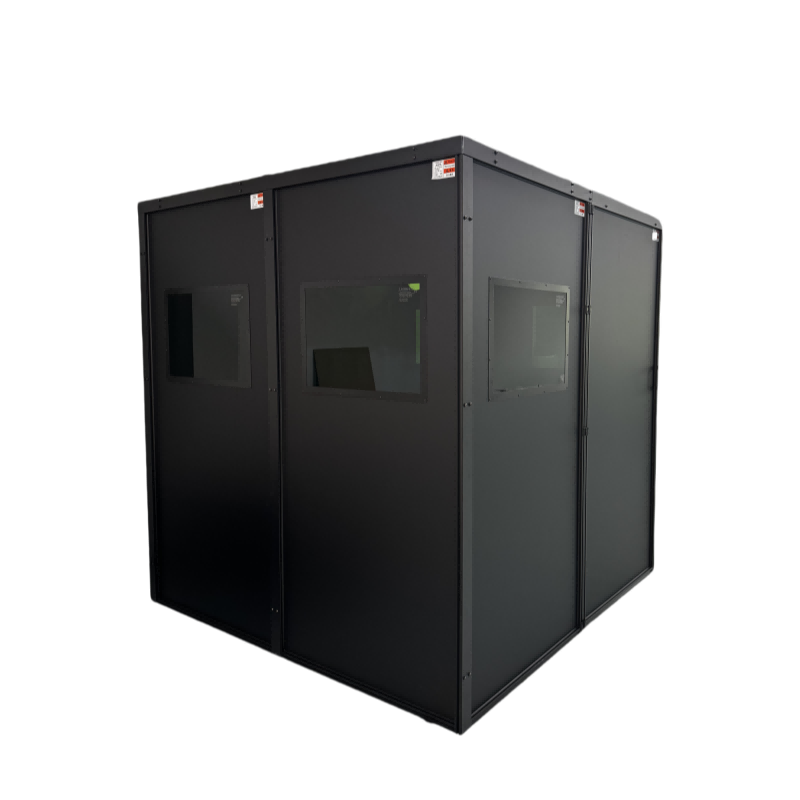
A dedicated laser safety house is engineered around the actual wavelength, power density, and beam path of your system. Instead of just blocking light, it combines interlocked access points, beam-absorbing internal linings, filtered ventilation, and viewing windows rated for the specific laser class. That means operators get full visibility while the enclosure manages reflections, fumes, and accidental exposure.
Yes. High-power setups are handled by layering different protective materials: a structural metal shell for mechanical stability, then dense polymer or glass filters tuned to the laser wavelengths, and often an internal sacrificial absorbing layer. For multi-wavelength systems, we mix panel types within the same house so each zone is matched to the beam it will actually see.
We start from the relevant standard envelope, usually IEC 60825 or ANSI Z136, and map every access point, viewing panel, and cable entry against the required optical density and interlocks. After assembly, the unit is tested with a calibrated source at the specified wavelengths, and we provide a complete test report and labeling package that your laser safety officer can keep on file.
It is, as long as the interface points are designed early. We often include high-speed roll-up doors for part loading, robot pass-through tunnels with brush or labyrinth seals, and safety PLC terminals that tie the enclosure interlocks directly to your line controller. The goal is to keep cycle time unchanged while making sure the laser cannot fire unless every opening is sealed.
We select window materials based on the laser wavelength and the expected scatter exposure, typically acrylic or polycarbonate filters with a hard coating on the outside to resist scratches and cleaning chemicals. Since scattered laser light is much lower intensity than the direct beam, the filter rating is calculated with a wide margin, but we also design the window frames to be replaceable without disassembling the whole house.
In many cases, yes. Our structures use a modular panel system, so you can swap side walls, add a larger door opening, or change the viewing window rating without replacing the floor frame or roof. We keep panel specifications on file for each serial number, which makes a later upgrade or expansion much simpler than starting over.
We offer both, but most production sites choose our supervised installation. A technician aligns the frame, verifies the interlock wiring, and performs the first light-off test with your laser team. Then we run a short hands-on session covering safe door handling, lockout procedures, and what to check during daily pre-start inspections.
Conclusion
Real-world laser work cells rarely match datasheet conditions, so our safety houses start with enclosures built to handle actual beam loads, including stray reflections and thermal cycling over long shifts. Material selection moves beyond simple acrylic or thin steel, using layered composites and impact-resistant viewing windows that keep operators protected without turning the workspace into a bunker. For non-standard production lines, we design custom safety houses around the equipment's footprint, access points, and workflow rather than forcing awkward add-ons.
Regulatory compliance is woven into the design from the first sketch, not bolted on during a pre-audit panic, which saves factories from last-minute rework and downtime. Retrofitting into busy facilities happens with modular panels and pre-assembled frames that minimize disruption to ongoing production. The long-term value comes from mounting systems and interlock integration that hold alignment and maintain shielding integrity even with constant door cycles and vibration, so protection does not loosen or drift over years of service.
Contact Us
Contact Person: Jenny
Email: [email protected]
Tel/WhatsApp: +86 13537713281
Website: https://www.laserpair-safety.com/