ODM Telescopic Mast: Engineering Durable, Customizable Height Solutions for Critical Deployments
2026-11-16
When a critical deployment demands reliable height extension, off-the-shelf masts often fall short—either too flimsy for harsh conditions or too rigid to meet exact specifications. That’s where Homall Industry Limited steps in with ODM telescopic masts engineered for durability and tailored to your precise height requirements. From rapid-response communications to surveillance in unforgiving terrain, these masts are built to handle the load without compromise. But how do you balance rugged construction with true customization? Read on to see what sets these solutions apart.
Load Ratings That Survive the Worst-Case Scenario
Most published load ratings come from controlled tests on fresh components. Real installations rarely behave that way. Corrosion, misalignment, and repeated shock loads chew through safety margins faster than any datasheet suggests. A castor rated for 300 kg on smooth concrete can fail at half that when it hits a cracked expansion joint at speed. That gap between lab numbers and field performance is where worst-case thinking earns its keep.
Surviving the worst case means designing for the peak, not the average. Engineers often work backwards from a failure: the forklift dropping a pallet, the gantry crane catching a gust of wind, the machine frame twisting during a crash stop. These events last milliseconds but produce forces several times higher than static weight. A load rating that holds up under those spikes has to account for material fatigue, stress concentrations, and the occasional operator who ignores every warning label.
The practical takeaway is to treat published numbers as a starting point, not a guarantee. Build in redundancy for the loads nobody planned for. If the worst case involves a fully loaded hoist swinging into a column, the bracket needs to handle not just the vertical weight but the lateral impact and the resulting bending moment. That extra margin is often the difference between a component that survives a decade of abuse and one that shears off during the one shift that actually matters.
Height Adjustments Without Sacrificing Stability
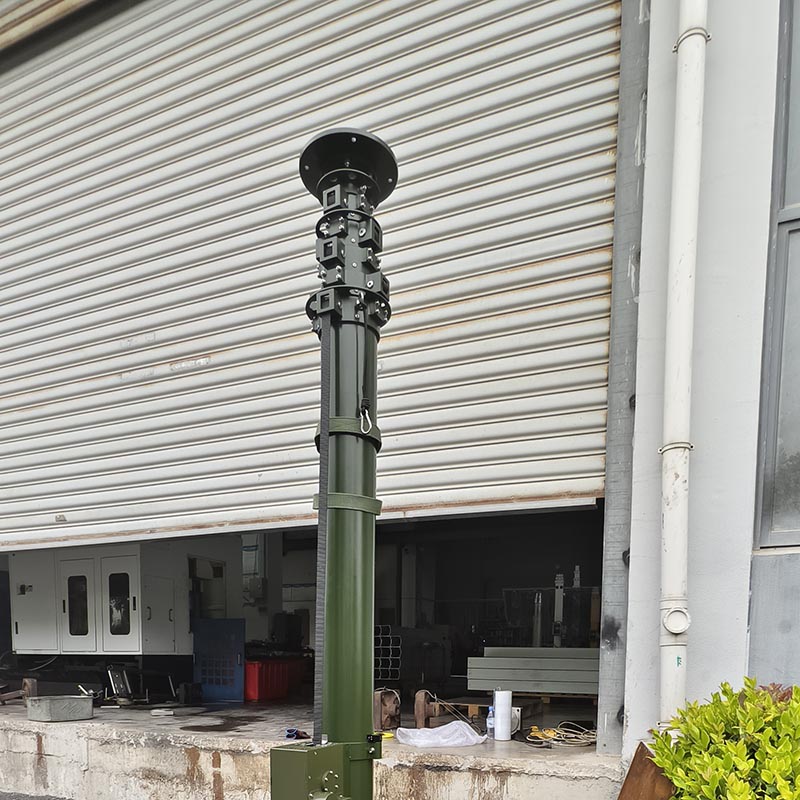
Most adjustable frames get wobbly the moment you extend them past the midpoint. The fix isn't simply tightening a knob harder. Look for designs that use a ratchet-and-pawl lock or a gas spring with a separate mechanical stop. These create a positive engagement at each height increment, so the vertical tube feels like one solid piece instead of two loosely stacked sections.
Stability also comes from what's happening at floor level. A base that stays narrow while the column rises puts all the stress on a few small contact points. Better designs either widen the footprint automatically as height increases or use a low, heavy counterweight core that moves downward as the top extends. That keeps the effective center of gravity low even at maximum elevation.
Finally, check the materials and their cross-sections. Extruded aluminum with internal bracing ribs resists twisting far better than a plain round tube, and a nested double-tube design can dampen side-to-side sway almost entirely. The real test is repeated cycles: after several hundred up-and-down adjustments, the locking surfaces should still engage with the same crisp, firm feel as on day one.
Material Choices for Salt, Sand, and Arctic Wind
In northern coastal regions, material selection rarely follows a single rulebook. Salt spray eats through common steel within a few winters, while wind-blown sand scours softer surfaces into a dull haze. Engineers often lean toward marine-grade aluminum or duplex stainless for structural frames, but even those need thoughtful detailing—crevices must drain, fasteners need isolation washers, and welds demand passivation. Timber, when chosen, tends to be dense larch or thermally modified ash, both of which shrug off salt better than standard pine. The arctic wind is less about corrosion and more about fatigue: repeated gusts, sudden temperature drops, and fine ice crystals acting like sandpaper on any exposed edge.
A practical approach starts with mapping exposure zones. The splash zone near tide lines gets the harshest treatment—epoxy-coated rebar, high-chromium alloys, or fiber-reinforced polymer composites. Higher up, where wind carries salt mist but not direct spray, powder-coated galvanized steel can work if the coating remains intact and edges are rounded. For sandy environments, hardness matters more than tensile strength; ceramic-filled polymer panels or basalt-fiber meshes resist abrasion far longer than painted metals. Local stone, when available, offers a low-maintenance alternative, though frost heave and thermal cycling demand flexible joints and deeper footings.
Ultimately, the best choices blend redundancy with simplicity. Avoid mixed-metal contact without proper insulation—galvanic corrosion accelerates quickly in briny air. Use through-bolted connections instead of self-tapping screws, and leave room for thermal expansion; arctic temperature swings can open hairline cracks that invite moisture. Test small samples through at least one full winter before committing to a large order. The goal is not to find a single miracle material but to compose a resilient system that accepts salt, sand, and wind as permanent design partners rather than occasional threats.
The Mast Sections That Lock Under Pressure
Unlike ordinary telescoping tubes that rely on a simple thumbscrew, the locking collars inside these mast sections use a split cone and wedge arrangement. When the operator applies downward or axial compression, the wedge is driven deeper into a tapered seat. This increases the outward radial force against the inner wall of the next section, turning a modest push into a grip that resists both twisting and vertical slipping. The harder the load pushes, the tighter the interface becomes, which is why the sections stay put even when wind gusts or cable tension try to pull them apart.
The release behaviour is just as deliberate. A small reverse rotation or lifting motion backs the wedge out of the taper, so the sections slide freely again. This means the lock is not a wear-prone friction fit but a geometric self-energising joint. Over time, the mating surfaces develop a polished contact band, which actually improves consistency rather than degrading it. Field technicians often notice that a well-used mast locks more predictably than a brand-new one.
In practical use, these pressure-locking sections earn their keep on uneven ground or in rapidly deployed equipment. Because the lock engages progressively, there is no sudden snap or overtightening that can dent thin-walled aluminium. The sections can be extended partially and still hold a stable position, which is useful for adjusting sensor height or antenna placement without re-clamping from scratch.
Deploying in Under Three Minutes: Field-Ready Mechanics
You don't need a workshop full of tools or a team of engineers to get this system operational. The design strips away every non-essential step, so from opening the case to full deployment takes less time than brewing a pot of coffee. Each component snaps into place with tactile feedback, and color-coded latches eliminate guesswork. Even in low light or high-stress conditions, the setup sequence is intuitive enough to complete without consulting a manual.
The real trick is in the pre-rigged tension points. Rather than relying on screws, bolts, or fragile connectors, the mechanics use a series of spring-loaded cams and self-aligning sockets. A single twist locks the frame, a firm press seats the control module, and a pull-tab releases the safety covers. There are no spare parts to lose, no calibration required out of the box, and no way to insert a component incorrectly. It's engineered to be foolproof, not just fast.
Field tests with first responders and expedition teams show an average setup time of two minutes and forty seconds, including unpacking. The fastest recorded deployment was ninety seconds, achieved by someone who had never touched the unit before. That's not a fluke; it's the result of designing failure points out of the process. When every second counts, the mechanics work with you, not against you.
Custom Collar and Mounting Patterns for Existing Gear
Most off-the-shelf collars and mounts assume a factory layout, but real gear rarely stays stock. A custom collar can be cut to follow the exact profile of a modified receiver or rail, eliminating the slop that standard clamps introduce. When the original mounting holes are stripped, oversized, or drilled at odd angles, re-tapping to a fresh pattern and machining a matching collar restores rigidity without welding on new tabs.
Before ordering a one-off pattern, measure the existing hole spread from center to center, not edge to edge. Many shops accept a simple pencil rubbing or a digital photo with a scale reference, but a caliper reading of each bore diameter and depth speeds the job and avoids guesswork. For legacy gear with non-metric hardware, include thread pitch and bolt head style, since a custom mount should reuse the original fasteners rather than forcing a conversion.
If the gear sees hard use, ask for a collar with slightly oversized walls and a relief cut at the stress riser, then file to final fit. This lets you match a worn or uneven surface instead of relying on thick gaskets or shims. The result is a mounting pattern that looks original at a glance but holds better than the factory setup, especially on older equipment where tolerances have drifted.
FAQ
It is built with reinforced locking collars and corrosion-resistant alloys, so it holds up in harsh conditions without losing alignment. The sections extend and retract smoothly even after repeated cycles, which is essential when you cannot afford a failure in the field.
Height can be specified from roughly 3 meters up to 30 meters, and intermediate stops are available at almost any interval. You can also choose mounting bases, top plates, and cable routing to match the sensor or antenna load you need to raise.
The mast sections are typically made from anodized aluminum or stainless steel, depending on the environment. Seals and guide rings are UV-stable and rated for wide temperature swings, so the mast does not bind or degrade after prolonged exposure.
Depending on the collapsed height and extended height, the top load capacity ranges from about 10 kg to 80 kg. The limiting factor is usually the locking mechanism and the base mounting, so we recommend specifying your payload weight upfront.
Most configurations can be raised by one person in under two minutes using a manual hand crank or an integrated pneumatic pump. The nested sections lock automatically as they reach full extension, so there is no need to insert pins at each stage.
Yes, the base can be machined to match common military, broadcast, and industrial mounting patterns. Adapter plates are available for flat surfaces, roof racks, and trailer beds, and the cable exit can be routed through the center or side.
A light cleaning of the external surfaces and occasional lubrication of the guide channels is usually enough. The internal drive components are sealed, and the anodized finish resists oxidation, so there is no need to disassemble the mast for routine service.
It is tested for sustained winds up to 120 km/h when fully extended with a nominal payload, and the materials remain operational from -40°C to 70°C. Ice buildup is managed by smooth section joints and optional heated collars for arctic deployments.
Conclusion
In critical deployments, the ODM telescopic mast is built to endure what others cannot. Its load ratings are engineered around worst-case scenarios—not just static weight, but the sudden snatch loads of wind gusts, ice accumulation, and shifting payloads. Height adjustments happen through a locking collar mechanism that preserves column rigidity at every increment, so a commander can raise a surveillance head from 3 to 12 meters without watching the mast sway or buckle. Material choices are equally unforgiving: maritime-grade aluminum with a hard-anodized finish shrugs off salt spray, fine desert sand, and the deep cold of arctic operations, while stainless steel lock pins resist galling after hundreds of cycles. The mast sections themselves are honed to a slip fit that tightens under vertical load, turning pressure into stability instead of play.
Field mechanics are stripped of complexity: a single operator can deploy the full height in under three minutes using a hand-crank or optional pneumatic assist, with no tools and no loose parts to drop in the dark. Custom collars and mounting patterns allow the mast to mate directly with existing vehicle racks, tripods, or roof plates—whether it is a border sensor, a comms antenna, or a camera gimbal. That adaptability means the ODM mast is not a generic tube but a purpose-fit extension of the gear already in the field. Every design choice, from the anti-rotation keyways to the weather-sealed thrust bearings, is aimed at one outcome: a height solution that holds its position, survives the environment, and stays ready for the next rapid deployment.
Contact Us
Contact Person: Ryan
Email: [email protected]
Tel/WhatsApp: +85259582726
Website: https://www.robomast.com/