
Sanitary Ware Vertical Lift Plating Equipment Supplier for High Performance Finishing Systems
2026-10-23
Sanitary ware manufacturers chasing flawless chrome finishes often hit the same wall: conventional plating lines can’t handle large, awkward parts without sacrificing consistency. That’s where vertical lift plating equipment changes the game. As a specialist supplier for high-performance finishing systems, Junda has spent years refining this technology to deliver uniform coatings, faster cycle times, and fewer rejects—even on complex basin and toilet geometries. In this post, we’ll unpack why vertical lift plating is becoming the go-to choice for premium sanitary ware lines, and how the right equipment partner can make all the difference.
Why Vertical Lift Plating Avoids the Usual Racking Marks
Traditional rack plating almost invites blemishes because parts hang motionless against metal hooks or clamps for the entire cycle. Those contact points shield the base material while surrounding areas build up deposit, so you get a ghost of the rack geometry in the finish. Vertical lift plating sidesteps this by moving the workpiece along the vertical axis in a controlled stroke. The short, repeated lift-and-lower action shifts how the part meets both the solution and the rack contact, preventing any one spot from sitting long enough under mask or current to burn a mark into the surface.
Drainage is another overlooked factor. When a part stays horizontal or tipped, solution can cling around rack fingers and leave behind drip lines as it evaporates. Vertical lift orients the part so spent electrolyte slides off in a thin, continuous sheet from the bottom edge, breaking cleanly instead of pooling. The result is a surface that exits the bath with fewer streaks, no secondary plating lines near contact areas, and a finish that looks consistent from centre to edge.
Designing Plating Lines Around the Weight of Sanitary Fixtures
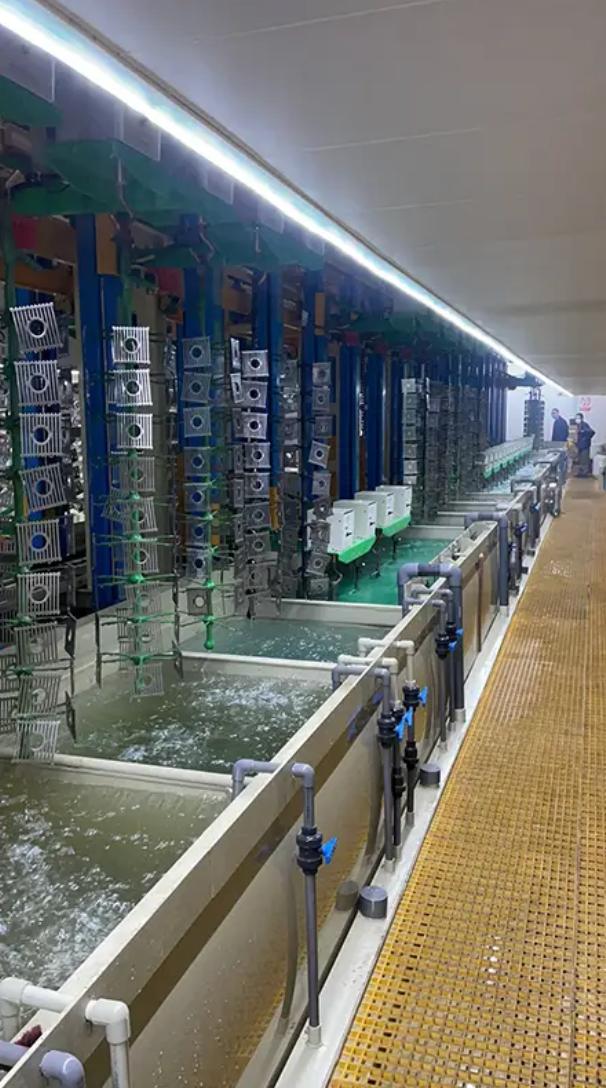
Weight is not a secondary concern in sanitary fixture plating; it dictates the physical framework long before chemistry enters the picture. A rack of cast brass bathtub spouts behaves very differently from a rack of lightweight zinc die-cast escutcheons. Flight bar sizing, hook spacing, and tank bracing all need to be calculated against the heaviest possible load, not an average. When that step is skipped, you see bowed racks, poor electrical contact, and thickness variation that no amount of bath adjustment can fix.
Heavier fixtures push you toward rack plating rather than barrel processing, but that choice brings its own demands. Hoists and carriers must handle the full wet load with enough reserve for drag-out trapped in deep cavities. Tank walls and anode baskets need extra clearance because dense parts shift current distribution in ways that thin, flat parts do not. Agitation also has to work harder: a heavy casting creates a thicker stagnant layer, so eductor placement and air sparge patterns should be tuned to break up solution film around the lowest, most shielded surfaces.
Jigging heavy sanitary components is less about hanging parts and more about distributing mass evenly across the rack. If one side carries a cluster of brass valves while the other holds only trim plates, the rack tilts, contact points wear unevenly, and plating thickness drifts. Use rigid hooks with positive locking, avoid nesting that traps solution, and consider auxiliary anodes for recessed areas where gravity and part density combine to limit current access. Small adjustments to rack balance and anode placement often yield better consistency than chasing bath parameters alone.
The Role of Anode Placement in High-Performance Finishing
Getting the anode position right changes everything about how a finish comes out. When the anode sits too close to the workpiece, you end up with uneven deposition and burned edges that ruin the surface. Pull it back too far and the current spreads thin, leaving dull patches and poor throw into recesses. The sweet spot depends on the part geometry, bath conductivity, and the specific plating chemistry you're running — but finding it means paying attention to how field lines actually behave, not just what the tank spec sheet says.
A common mistake is treating the anode as a uniform source. In reality, its placement sets up a potential map across the entire rack. High-current-density zones near edges and corners need either shielding or a shifted anode angle to flatten the distribution. For complex parts, multiple anodes or conforming anode shapes often outperform a single large plate. The goal is to balance the local current density so every square centimeter sees roughly the same deposition rate, even if that means repositioning the anode mid-run after measuring thickness variation.
What separates high-performance finishing from ordinary plating is this kind of iterative tuning. You move the anode, run a short test, map the thickness with X-ray or eddy current, then adjust again. Over time, you learn how a given bath responds to shifts of a few millimeters. That knowledge lets you push current density higher without sacrificing uniformity — which directly translates to faster cycles, better corrosion resistance, and a finish that holds up under close inspection.
How to Spot a Supplier That Understands Sanitary Ware
A genuine understanding of sanitary ware goes far beyond a glossy catalog or a warehouse full of boxes. You can spot it in the way a supplier talks about ceramic density, glaze composition, and the subtle differences between a one-piece and a two-piece toilet. Ask them why a particular basin has an overflow slot placed slightly off-center, or how their vitreous china holds up under repeated thermal shock. If they pause only to fetch a technical sheet, that's a good sign. If they say 'all toilets are basically the same,' walk away.
Another tell is how they handle water efficiency versus real-world flushing performance. A supplier who understands the category will ask you about your water pressure range, rough-in distance, and even the age of your drainage pipes before recommending a model. They won't just push the lowest gallon-per-flush rating; they'll explain why a wider trapway or a glazed siphon jet matters more in older buildings. They might even suggest a pressure-assisted option for a basement bathroom while steering you toward a gravity flush for a quiet master suite.
Finally, look at how they respond to warranty and after-sales questions. A knowledgeable sanitary ware supplier will mention specific parts like fill valves, flappers, and mounting hardware by name. They'll have opinions on which seat hinges tend to loosen first and why certain chrome finishes show water spots more than brushed nickel. When you ask about a cracked tank or a chipped rim, they should be able to tell you exactly how the replacement process works—not just hand you a generic support email. That depth of familiarity is what separates a real partner from a box mover.
Overcoming Drainage and Entrapment Issues in Fixture Plating
Plating solutions tend to pool in recesses, blind holes, and tight clearance areas of fixtures, leading to uneven deposit thickness, staining, and cross-contamination between baths. Standard draining time alone rarely clears these pockets because surface tension and capillary action hold liquid in narrow gaps.
Instead of relying on a single large drain hole, break the fixture body into open channels or add angled slots that direct fluid toward the lowest point. Use countersunk perforations where panels or clamps meet, so liquid cannot form a meniscus bridge. For fixtures that must retain small parts, replace solid backing plates with perforated or mesh supports to promote through-flow.
During line operation, a brief tilt or rotation after withdrawal from each tank can release trapped solution before the fixture moves to the next station. Air knives or low-pressure compressed air aimed at blind pockets also help, but they need to be positioned so they do not blow droplets onto already-plated surfaces. Periodic teardown and cleaning of fixture joints removes dried salts that gradually narrow drainage paths.
Batch Consistency Strategies for Large-Volume Finishing
Large-volume finishing rarely fails from a single bad part; it fails when the process drifts and nobody catches the shift in time. The core of batch consistency is not inspecting every piece after the fact but locking down the variables that can wander—tool pressure, media breakdown, coolant condition, and even ambient humidity. Many shops start with an acceptable range for each parameter, but the real trick is tracking how those values interact. A slightly dull belt and a two-degree temperature swing might each be fine alone, yet together they can push edge rounding or gloss out of spec.
One practical strategy is to anchor each product line with a "golden batch" baseline: a set of reference workpieces and recorded process settings that represent the target output. New batches are compared against that baseline at defined intervals, not just at final inspection. Adding statistical process control on top helps filter out normal noise from genuine drift. For example, charting surface roughness every 30 minutes catches a gradual loss of abrasive cutting power long before visual inspection would. Media management also deserves attention—pre-blending large lots of polishing stones or compounds reduces the variability that comes from switching suppliers or opening a fresh container.
Finally, operator influence should be minimized wherever possible. Even with clear work instructions, subtle differences in loading angle, dwell time, or cleaning between stages can create batch-to-batch swings. Fixtures that lock parts into the same orientation, automated feed systems, and single-button cycle starts remove many of these micro-variations. Documenting every parameter change—and requiring sign-off when anything deviates from the golden batch settings—turns consistency into a repeatable habit rather than a daily hope.
FAQ
Vertical lift lines allow workpieces to enter and exit tanks at a controlled angle, which improves solution coverage inside recessed areas and reduces air pockets. The design also supports heavier rack loads without putting excessive strain on conveyor chains, so larger batches of faucet bodies, shower arms, and valves can be processed with fewer defects.
We combine adjustable anode spacing, targeted air or eductor agitation, and programmable rectifier ramps for each part family. For high-shine sanitary finishes, the software can store individual recipes that set lift speed, dwell time, and current density zones, which helps maintain a consistent thickness even around tight bends and threaded connections.
The lifting carriages are designed for quick changeover, with clamp positions and rack pitch that can be adjusted without cutting or welding. Saved recipes let operators recall a full process sequence for a new part number in under a minute, and bypass paths allow the line to skip pre-treatment stages when only re-plating or touch-up work is needed.
Yes, each carrier can be fitted with RFID tags or barcode scanners, and the PLC records tank temperatures, rectifier outputs, and transfer times for every load. That data can be exported to your MES or ERP system, giving you a time-stamped history of each rack without adding manual paperwork.
A typical mid-capacity installation for sanitary ware occupies roughly 18 to 25 meters in length and 4 to 5 meters in width, depending on the number of process stages and rinses. The vertical lift design keeps the floor plan narrower than overhead hoist lines because the carriage runs on floor-mounted rails and doesn't require overhead steelwork.
The lift cycle includes a programmable drain pause above each process tank, and we can add a tilting or oscillation feature to help solution run back before the transfer. Rinsing uses counterflow cascades and, where possible, a drag-out recovery tank, which cuts chemical consumption and reduces the load on waste treatment.
Yes, the same line can run bright nickel, satin nickel, and chromium for decorative finishes, then switch to hard chrome or electroless nickel for functional wear resistance by using separate rectifier programs and tank assignments. This avoids the need for two independent lines when your catalog includes both polished and matte product families.
Conclusion
Vertical lift plating changes how sanitary fixtures are handled during finishing. Instead of stationary racks that leave contact points and shadow marks, the lift motion repositions the part throughout the bath cycle, so current distribution stays even and visible rack marks fade from the final surface. This matters for heavy vitreous china or cast iron basins and toilets, where the carrier system must be engineered around the fixture's weight rather than borrowed from lighter decorative plating. A well-designed line uses reinforced flight bars, balanced lift arms, and anode placement that follows the deep contours of a bowl or trapway, not just a flat panel. Otherwise, the inside of a pedestal or the underside of a rim gets thin, dull, or burnt deposits while the outer surface builds too much thickness.
The real difference appears with suppliers who know sanitary ware's drainage and entrapment issues. A fixture tilted slightly wrong holds solution in the trap, causing streaking, staining, or chemical carryover between tanks. Thoughtful racking angles, drain holes, and air agitation profiles force liquid out of hidden cavities without slowing the lift cycle. For large-volume finishing, batch consistency comes from controlling those variables across hundreds of identical pieces, not just one showroom sample. A supplier worth considering will discuss load cell verification on lift arms, anode shielding near the bowl's water spot, and how they map current density across a full rack. They will also ask about your specific fixture geometry and production mix before quoting a line, because a vertical lift system tuned for a wall-hung basin performs differently on a floor-mounted water closet. That level of engagement separates a general plating vendor from one that actually understands high-performance sanitary ware finishing.
Contact Us
Contact Person: hayyr
Email: [email protected]
Tel/WhatsApp: 8613082110525
Website: https://www.jundaelectroplating.com