Sliding DU Bushing Manufacturer: Precision Components for Reliable Performance
2026-10-31
When your machinery demands frictionless motion under brutal loads, standard bushings quietly surrender. Sliding DU bushings flip that script — pairing a steel backing with a PTFE-lead lining to shrug off wear, dampen vibration, and keep tolerances tight where off-the-shelf parts fail. But not every manufacturer pours the same obsession into heat treatment, surface finish, and dimensional consistency. That’s where XIAYI earns its place on your shortlist: a sliding DU bushing maker that treats each batch as a precision component, not a commodity. In this post, we’ll break down what separates reliable DU bushings from marginal ones, how to read performance specs without getting lost, and why partnering with a focused manufacturer changes your maintenance math. Stick around — your next design review might finally stop dreading the bushing conversation.
What Gives DU Bushings Their Edge Over Bronze?
The real advantage starts with construction. A DU bushing is not a single piece of metal but a layered composite. A steel shell supplies structural rigidity and dimensional stability, while a sintered bronze inner layer provides excellent thermal conductivity and a strong mechanical bond. That bronze layer is then impregnated with PTFE and lead compounds, creating a dry running surface that never needs a grease fitting or a maintenance schedule. Bronze, by contrast, relies on an external lubricant film, and once that film breaks down under high load or low speed, wear accelerates quickly.
That structural difference also changes how friction behaves over time. DU bushings typically show a lower coefficient of friction than bronze, especially in boundary or dry conditions where bronze tends to gall or stick-slip. Because the PTFE-rich layer is self-renewing during operation, DU maintains consistent motion without the periodic re-lubrication bronze demands. In applications with dirty, hard-to-reach, or poorly lubricated spots, DU often lasts longer and simplifies design by eliminating oil grooves, grease paths, and the need for external lubrication systems.
How We Keep Every DU Bushing Within Micron Tolerances
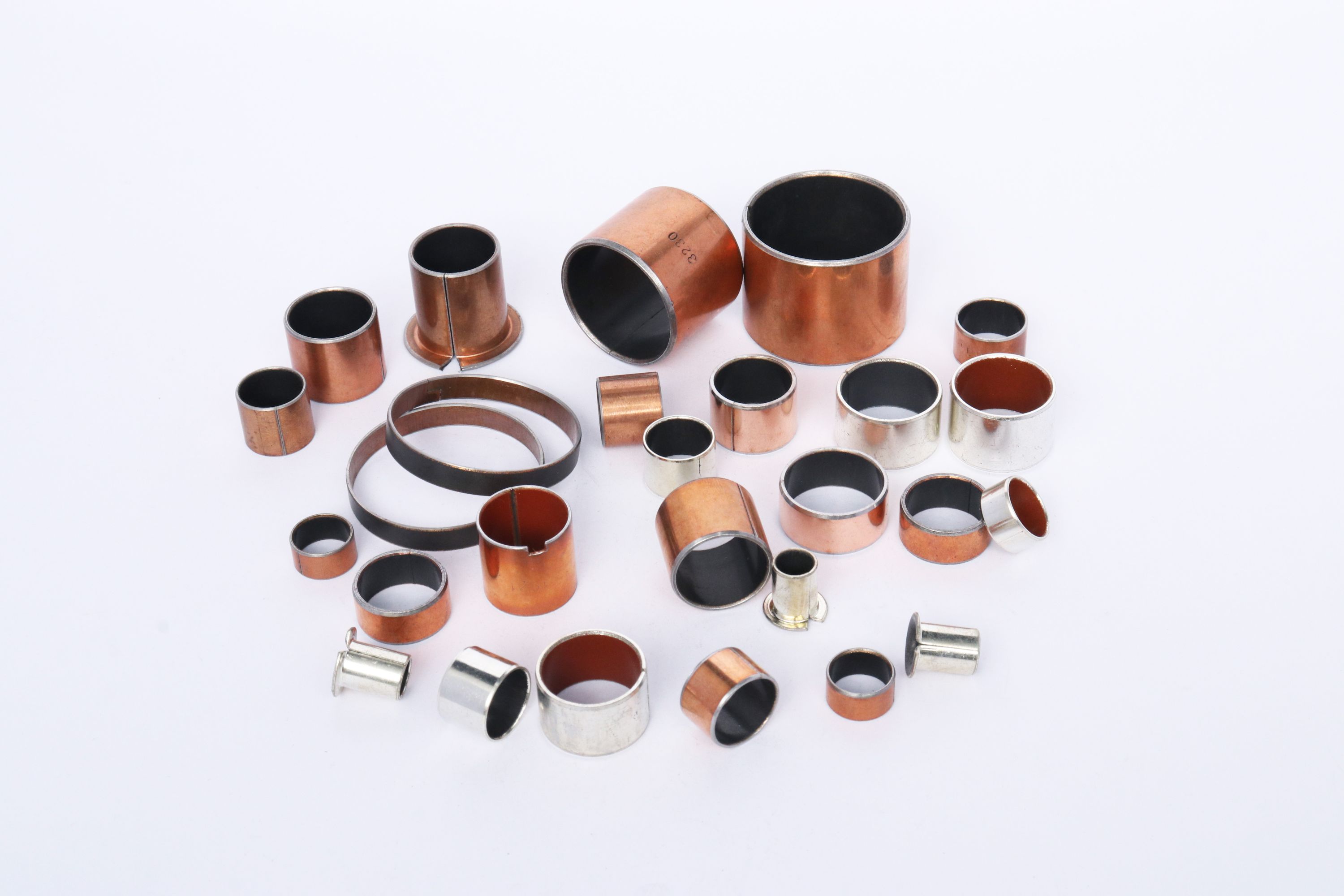
Hitting micron-level tolerances on a DU bushing isn't something you leave to chance or final inspection. It starts with raw material control. Every batch of steel backing and sintered bronze layer is checked for thickness variation before it reaches the forming line. We don't just trust the mill certificate; we run our own laser scans on incoming coils. This lets us reject material that would drift out of spec halfway through the press cycle, saving time and preventing scrap.
The forming and sizing stages are where the real precision happens. Our presses use closed-loop feedback that measures wall thickness every few milliseconds and adjusts punch pressure automatically. Instead of relying on a fixed stroke, the tooling compensates for springback and slight hardness changes in the steel. After the bronze layer is sintered and the PTFE-based liner is bonded, each bushing passes through an air gauge station that checks ID, OD, and roundness at three points along its length. Anything outside the allowed band gets pulled immediately, and the data feeds back to adjust the previous station.
What keeps us within microns isn't a single machine or clever fixture. It's the habit of measuring from the start and correcting before a trend appears. Operators log every shift's first-piece readings against a master ring, and the tooling department tracks wear on mandrels and dies. That way, a drift of two or three microns shows up as a maintenance note, not as a customer complaint. For DU bushings running in high-load, low-speed applications, that kind of consistency means quieter operation and longer service life.
PTFE vs. POM Liners: Which DU Bushing Suits Your Load?
If your application keeps chewing through PTFE-lined DU bushings under moderate to heavy radial loads, the problem isn’t the bushing design—it’s the liner. PTFE delivers an ultra-low friction coefficient and genuinely dry running, but it cold-flows under sustained pressure. That means the liner deforms, thins out at the load zone, and eventually exposes the bronze interlayer. For high static loads, frequent start-stop cycles, or oscillating motion where the shaft never gets a full rotation to redistribute lubricant, a POM liner is usually the better call. Acetal resin has far higher compressive strength and creep resistance, so it holds its shape under loads that would squash PTFE.
The trade-off is friction and temperature. POM doesn’t glide as freely as PTFE dry, and its upper service temperature sits lower—typically around 100°C continuous compared to PTFE’s 250°C plus. You also give up some of PTFE’s chemical inertness. So if you’re running light, fast, low-load continuous rotation in a clean environment, standard PTFE DU is still ideal. But when the load per projected area climbs past what pure PTFE can handle without creeping, or you’re dealing with shock and edge loading, switching to a POM-lined DU bushing often doubles service life without changing housing dimensions.
Where DU Bushings Actually Work: Automotive, Pumps, and Beyond
In automotive systems, DU bushings show up in places you might not immediately notice — throttle linkages, seat adjusters, door hinges, and even steering column pivots. Their self-lubricating design cuts down on squeaks and wear without adding grease fittings, which keeps assembly lines faster and maintenance intervals longer.
Pump manufacturers rely on them for a different reason: intermittent dry starts and low-speed operation. A DU bushing in a gear pump or vane pump can handle brief starvation without galling the shaft, and the thin PTFE-lead layer shrugs off water and most process fluids. That makes them a practical choice for everything from fuel transfer pumps to small hydraulic power units.
Beyond those two sectors, the same bushing finds work in textile machinery, packaging equipment, agricultural implements, and even medical devices. Anywhere a compact, low-maintenance plain bearing needs to survive oscillation rather than full rotation, DU tends to outlast sintered bronze and cost less than needle rollers. The real advantage is simplicity: no external lubrication circuit, no hardened shaft requirement, just a press-fit and a finished bore.
Getting Custom DU Bushings Sized to Your Specs in Days, Not Weeks
Off-the-shelf DU bushings rarely match every bore or shaft dimension, and forcing a near-fit leads to uneven wear or early failure. That's why we keep a stock of standard blanks and finish them to your exact ID, OD, and length within days. Send your drawing or a measured sample, and we'll handle the rest.
The real advantage isn't just speed—it's that you stop settling. You get the right interference fit, the right wall thickness for your load, and the right length for your housing, without waiting for a full custom production run. For maintenance teams and prototype builders, that means less downtime and faster testing.
Even with a quick turnaround, every bushing is checked against your specs before it ships. No rush job tolerances, no close-enough sizing. Just DU material—steel backing, sintered bronze, PTFE liner—machined to work in your application from day one.
Accelerated Wear Testing: How We Predict DU Bushing Service Life
Predicting how long a DU bushing will survive in the field isn't something we leave to guesswork. We run accelerated wear tests that compress years of service into a matter of weeks. The test rigs are set up to mimic the exact combinations of load, sliding speed, and temperature cycling that a bushing would see in a hydraulic cylinder or a pivot joint, but we push those parameters beyond normal operating ranges. By tracking wear depth at fixed intervals and measuring the coefficient of friction as the PTFE layer wears down, we can map out the wear progression under aggressive conditions.
From there, the data goes into a modified Archard wear model that accounts for the non-linear break-in phase and the transition from the overlay to the porous bronze interlayer. We don't just extrapolate a straight line; we use the early high-wear phase to calibrate the model for each batch of material. This gives us a curve that predicts the point at which the bushing will exceed its allowable clearance. To make sure those predictions hold up, we cross-check accelerated results against field returns and long-term bench tests at moderate loads. The correlation is tight enough that we can usually predict service life within a 15% band.
One thing to keep in mind is that accelerated testing is only as good as the assumptions behind it. If the real application has frequent shock loads or dirty environments, those variables get added to the test cycle deliberately. We also run multiple samples from different production lots to catch variance in the bronze sintering or the PTFE impregnation. The end result is a service life estimate that our engineers can stand behind, not a generic catalog number. For customers, it means fewer unexpected teardowns and a better match between bushing choice and actual duty cycle.
FAQ
We start with a steel backing, sinter a porous bronze layer onto it, then infuse and roll a PTFE-lead compound into the surface. That gives a maintenance-free bearing with a low coefficient of friction and good wear life. Every batch gets checked for wall thickness, ID tolerance, and surface finish before it leaves.
Yes. The DU structure is designed for high load, low speed oscillating or rotating movements. Typical dynamic load capacity is around 140 N/mm² depending on dimensions, and they work in temperatures from -200°C to 280°C. That makes them suitable for hydraulic cylinders, agricultural equipment, and industrial linkages.
We do. Beyond standard metric and inch sizes, we can produce non-standard IDs, ODs, lengths, flanges, and even do secondary operations like grooving, chamfering, and drilling. Send us your drawing or sample, and we can turn around a prototype in about two weeks.
None in most cases. The PTFE-based running layer transfers a thin film to the mating surface, so the bushing is self-lubricating. You can use it dry, or add grease if you want to extend service life in dirty environments. No routine maintenance is needed.
Standard DU material contains a small amount of lead in the PTFE compound for improved wear resistance, and it is RoHS compliant under the current exemptions. If you need a completely lead-free version, we offer a POM-based alternative or a PTFE compound without lead, but load capacity may be slightly lower.
We inspect incoming steel strip thickness and hardness, monitor sintering temperature and time, control the impregnation and rolling process, and then do 100% dimensional checks on critical dimensions. We also run periodic wear tests and layer adhesion tests to make sure the bronze and PTFE layers won't separate in service.
They're used in automotive suspension and steering systems, hydraulic cylinders, food processing machinery, textile machines, office equipment, and general industrial linkages. Anywhere you need a compact, maintenance-free bearing that can take high loads without stick-slip.
Yes. We keep standard sizes in stock for quick shipment, and for larger volumes we can schedule dedicated production runs. Our normal lead time for non-stock sizes is 3-4 weeks, but we can shorten it if you have an urgent requirement.
Conclusion
Unlike sintered bronze, DU bushings combine a steel backing with a porous bronze intermediate layer and a low-friction polymer liner. This structure handles higher loads and resists edge loading without the stick-slip or galling common with bronze. Our production team holds every bushing to micron-level tolerances through in-line gauging and final inspection, so the interference fit and running clearance stay consistent batch after batch. When selecting a liner, PTFE suits high-speed, low-load positions where dry running is frequent, while POM works better for moderate loads and oscillating motion. That straightforward choice lets buyers match the bushing to the actual load profile instead of guessing.
Beyond material selection, these bushings appear in hydraulic pumps, steering columns, hinge points, and industrial conveyors—anywhere a compact, maintenance-free pivot is needed. We also cut lead times for custom sizes: standard tooling covers most diameters, and CNC turning finishes non-standard dimensions in a few days, not weeks. Before shipping, accelerated wear tests run bushing samples against hardened shafts under controlled load and speed. By measuring wear depth over cycle counts, we predict service life and feed that data back to the customer, so the part that arrives on your dock carries a realistic operating envelope.
Contact Us
Contact Person: Leela
Email: [email protected]
Tel/WhatsApp: 8613586885132
Website: https://www.xiayishockparts.com