
Solar Fan Factory: Inside the Production of Energy-Saving Cooling Devices
2026-09-16
Most cooling fans claim to be efficient, but few are built from the ground up with solar in mind. At SRS, energy-saving isn't a marketing phrase—it's a manufacturing discipline. Step inside our solar fan factory and see how every rotor, blade, and panel is calibrated to turn sunlight into reliable airflow, cutting both carbon and electricity bills.
The Recycled Polymer Line That Kicks Off Every Solar Fan Build
Every solar fan starts with a humble strip of recycled polymer, pulled from the same feed line that turns discarded bottle caps and worn-out crates into precision-molded fan housings. The material isn't just a token green gesture; it arrives pre-sorted, washed, and re-pelletized to meet strict melt-flow and impact-resistance specs before it ever touches a mold.
On the line, operators dial in barrel temperatures and injection pressures to match the polymer's slightly softer memory, then watch as the first shots fill the cavity with a consistent, matte-finish shell. That shell becomes the backbone for mounting brackets, blade guards, and the solar panel cradle, so any warp or shrink here would ripple through the entire build. A quick laser check for wall thickness and a snap test for brittleness keep rejects from moving forward.
Because the recycled feedstock varies from batch to batch, the line includes a small blending station that fine-tunes color and flex without resorting to virgin plastic. This is where a solar fan gets its weather-proof skin and its quiet, vibration-damping frame; it's also where the carbon math works out: roughly 40% less energy than using new polymer, and a second life for material that would otherwise sit in a landfill.
A Peek at the Workstations Where Copper Coils Meet Sun-Charged Batteries
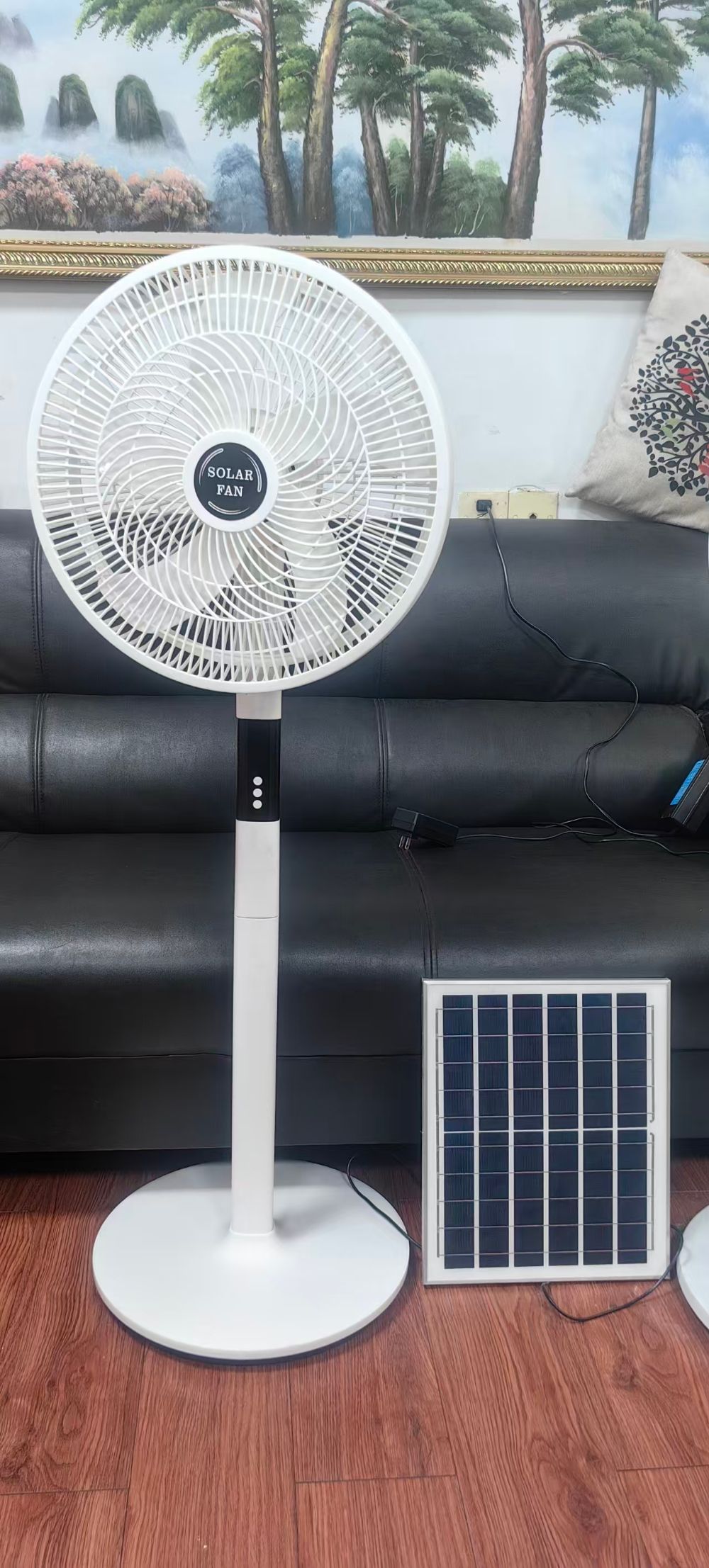
Along the north wall, a repurposed oak desk holds a row of copper coils wound by hand, their lacquer still carrying the faint smell of solder. Each coil sits next to a sun-charged battery still warm from the window ledge, waiting to be wired into a test circuit.
Clamps keep the loose ends from touching, and a strip of masking tape labels one battery “Tuesday – full sun.” A multimeter, scratched around the dial, reads the first coil’s resistance while a notebook open to a hand-drawn diagram tracks which pair produced the cleanest discharge.
The station isn’t tidy. Cable offcuts curl in a glass jar, and a cracked ceramic dish holds tiny neodymium magnets. But that clutter is what makes the setup work: it’s a bench for trying things, not for display.
Why This Plant Tests Every Fan Under a Simulated 2 PM Sun
At this plant, the simulated 2 PM sun isn't chosen by accident. By mid-afternoon, ambient temperatures peak while solar irradiance still holds near its daily maximum, creating the harshest thermal load a fan will ever face. The test rig pairs high-intensity lamps with a heated chamber to reproduce that exact combination, pushing each unit to its limit before it ever leaves the line.
Testing every single fan, rather than a random sample, comes down to how a single failure cascades. In outdoor enclosures or grow-light arrays, one stalled fan can raise internal temperatures by tens of degrees within minutes, damaging sensitive electronics or stressing plants. So this plant runs each fan through the full simulated-afternoon cycle, logging RPM stability, noise drift, and bearing temperature. Any fan that shows a deviation gets pulled, even if it would pass a typical bench test.
The Blade Balancing Jig That Quietly Defines Airflow Quality
In high-performance fan systems, even the smallest imbalance in a blade assembly can create turbulence that undermines airflow consistency. A well-designed balancing jig addresses this at the source, holding each blade in a fixed reference position while technicians adjust weight distribution. The result isn't just smoother rotation—it's a quieter, more predictable stream of air that downstream components rely on.
What makes this particular jig stand out is the way it removes guesswork from the process. Instead of relying on feel or repeated spin-down tests, it uses a simple but repeatable pivot mechanism to reveal residual imbalance quickly. This allows small corrections to be made before the fan ever reaches its operating speed, which is where most airflow quality issues tend to surface.
Over time, the cumulative effect of these small adjustments shows up in measurements that matter: reduced vibration transfer, lower acoustic noise, and a more uniform velocity profile across the fan outlet. It's the kind of tool that never gets much attention, yet it quietly sets the baseline for everything that follows in the air path.
How Off-Grid Cooling Demands a Different Kind of Durability Check
Most durability tests for cooling equipment assume a stable grid connection, consistent voltage, and a technician within an hour's drive. Off-grid systems get none of that. The real stress points aren't just compressor cycles or refrigerant leaks—they're dust-clogged solar panels, battery banks that dip below critical voltage on cloudy days, and control boards exposed to temperature swings from freezing nights to 45°C afternoons. A unit that survives a lab bench for ten years can fail within months when the only power source fluctuates daily.
Field checks need to account for what happens when nothing is plugged into a wall. That means testing charge controllers against brownouts, verifying that insulation can handle roof temperatures above 70°C, and making sure the fan bearings tolerate fine desert grit. It also means accepting that replacement parts may take weeks to arrive, so the system has to limp along in degraded mode rather than shut down completely. If a cooling unit can't keep food or medicine safe for a week without maintenance, it isn't durable enough for off-grid use.
Last Stop Before Shipping: The No-Load Run and Final Whir Audit
The machine is already bolted to its test skid, oiled, and wired for the last time before crating. We run it with no load—just the shaft spinning free, the bearings warming up, the gear teeth finding their familiar mesh. My ear is a few inches from the housing, listening for any tick, scrape, or uneven whir that would have been masked under a full production load. This is the moment where a slightly tight bearing or a misaligned coupling shows itself, not as a catastrophic failure, but as a faint harmonic that doesn't belong.
The final whir audit isn't about checking boxes. It's a five-minute listen with the back of a screwdriver pressed to the casting, feeling for vibrations that travel up through the handle. If the pitch stays steady and the temperature rise on the bearing caps stays within a couple of degrees, we sign off. Only then does the unit get drained, sealed, and wrapped for the truck.
FAQ
Each cell gets scanned for micro-cracks before a worker places it into the frame by hand. The wiring is soldered in small batches, and then the panel is cured under UV lamps to lock out moisture. Only after a flash test confirms output do the panels move to fan assembly.
The housing includes a small lithium-iron-phosphate pack that charges during peak daylight. A charge controller automatically switches the fan to battery mode when panel voltage drops below a threshold, so airflow barely stutters.
The factory uses glass-reinforced ASA for the blades and outer shell. It gets baked in accelerated weathering chambers that mimic five years of UV exposure in about six weeks. If there's any warping or color shift, the batch is rejected.
Every brushless DC motor goes through a sound booth test. Technicians run it at three speeds and listen for bearing whine. Units that exceed 28 decibels at one meter are pulled for rebalancing or bearing replacement.
Copper scraps are collected in labeled bins and sent to a local recycler. Cracked cells get crushed and used as aggregate in concrete blocks. The factory tracks scrap weight weekly and adjusts cutting patterns to reduce offcuts.
Yes, a rooftop test rack holds sample units from each shift. They run for a full day while data loggers record RPM, airflow, and panel current. A unit has to match the reference curve within five percent to approve that production lot.
There's no long conveyor with anonymous stations. Teams of four build a complete fan from start to finish, so one group owns the quality of each unit. The line can also switch blade diameters in under an hour because fixtures are mounted on quick-release plates.
Conclusion
Inside this factory, production doesn't start with raw plastic pellets but with a steady stream of recycled polymer regrind. That material feeds the first line, where fan housings and blade sets take shape under low-energy heat. Nearby, the real magic happens at dense workstations: workers hand-wind copper coils, then mate them to sun-charged battery packs. There's no conveyor-belt rush here—each station moves at the pace of precise manual checks, ensuring every connection survives the daily cycles of a solar panel's output. The air smells faintly of ozone and warm solder, a reminder that off-grid cooling isn't assembled like a disposable desk fan.
Quality control gets unusual. Instead of a simple spin-up, every finished unit is placed under lamps calibrated to mimic a 2 PM sun—the harshest angle for heat and glare. A blade balancing jig, little more than a precision pivot and a counterweight, sorts out even half-gram imbalances that would later whine or wobble. For off-grid use, the plant runs a separate durability gauntlet: vibration rigs, dust chambers, and rapid temperature swings that would crack a typical home fan. Only then does a fan reach the final bench, where it runs no-load for thirty minutes while a technician listens for anything beyond a clean whir. A passing unit sounds less like a machine and more like a quiet breeze you'd trust in a remote cabin.
Contact Us
Contact Person: kitty
Email: [email protected]
Tel/WhatsApp: +8618676039824
Website: https://www.srssolargroup.com/