
Substantial Distal Access Catheters: Enhancing Precision and Control in Endovascular Interventions
2026-10-07
Ask any interventionalist—the distal vasculature is where procedures are won or lost. It's also where standard catheters frequently fall short, buckling or losing trackability exactly when precision matters most. Substantial distal access catheters are changing that calculus. By prioritizing robust construction and responsive control, they provide the stability needed for complex endovascular work. INT has been at the forefront of this evolution, turning a once-limitation into a clinical advantage.
From Hub to Tip: The Mechanical Logic of Distal Access
The real challenge in distal access isn't just reaching the target—it's preserving the intended motion across every millimeter of the device. When you rotate the hub, that input travels through a long, flexible shaft, and along the way it can be dampened, delayed, or even reversed by stored torsional energy. A well-designed system manages this by balancing stiffness near the proximal end with controlled compliance distally, so the tip responds predictably rather than whipping or lagging.
Push forces follow a similar logic. A hard shove at the hub doesn't translate into forward movement if the shaft bows, stores axial load, or transfers too much force to the vessel wall. Instead, the mechanical pathway must be tuned so that force is delivered incrementally—enough to advance the tip without overwhelming the anatomy. This is why distal access devices often combine a supportive proximal segment with a softer, more trackable distal segment, allowing the operator to read tactile feedback and adjust in real time.
At the tip, every mechanical decision upstream becomes visible. If torque isn't transmitted cleanly, the tip will flip or resist. If pushability is too aggressive, the tip will prolapse. The logic from hub to tip is therefore not just about stiffness or lubricity in isolation, but about how those properties interact along the entire length. Getting that interaction right is what separates a catheter that simply reaches from one that actually performs.
Where Tortuosity Meets Its Match: Distal Catheter Design in Practice
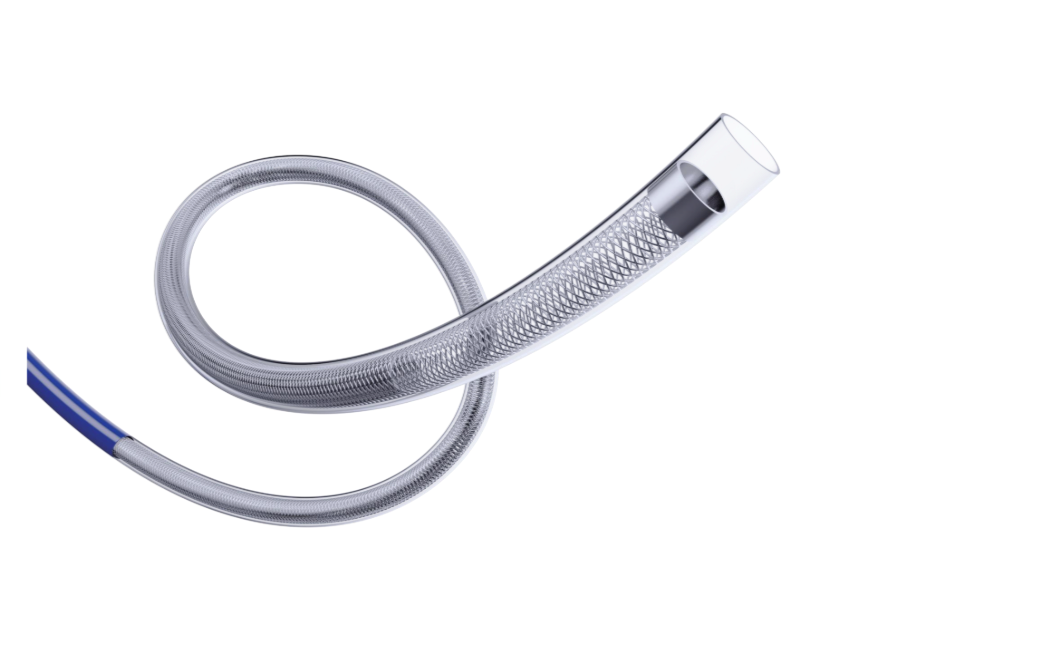
The moment a guidewire meets a sharply angulated vessel, most distal catheters betray their stiffness. In practice, the difference between a smooth crossing and a frustrating series of prolapses often comes down to how the distal segment transitions from shaft to tip. Rather than relying on a single tapered zone, the more effective designs distribute flexibility across several short, graduated segments. This lets the catheter load onto the wire without buckling, preserving pushability even when the anatomy doubles back on itself.
Tortuosity also exposes the limits of purely axial support. A distal catheter that tracks well in a straight iliac system can hinge painfully in a carotid loop or a calcified takeoff. Here, wall thickness and material choice matter as much as the curve of the tip. Softer durometers paired with a reinforced proximal shaft give the operator enough leverage to rotate through bends while keeping the leading edge atraumatic. It is a balance that no single bench test captures; it only becomes obvious after a few cases where the catheter either holds the wire’s line or fights it.
Perhaps the most underrated feature is the inner lumen surface. In tortuous segments, the wire is constantly sliding against the catheter wall under tension. A polished or hydrophilic inner coating reduces that drag enough to prevent the wire from locking when the catheter is mid-rotation. When combined with a tip that doesn’t ovalize under repeated torque, the catheter feels less like a passive tube and more like an extension of the wire itself—precisely what tortuous anatomy demands.
Aspiration, Injection, and the Physics of a Larger Lumen
When you pull back on a syringe plunger to aspirate, the lumen diameter dictates how easily fluid moves. A larger lumen reduces resistance dramatically because flow rate scales with the fourth power of the radius under laminar conditions. That means a small increase in bore size can cut the pressure needed for a given volume by a surprising margin, which matters when you're dealing with viscous fluids or fragile tissues.
On the injection side, the same physics applies in reverse. Pushing a medication through a narrow needle can require high force and create a focused jet that damages cells or causes pain. A wider lumen allows the same dose to be delivered more gently, with lower pressure and less shear stress on suspended particles. This is especially relevant for platelet-rich plasma or cell therapies, where preserving viability depends on minimal mechanical trauma.
That said, larger isn't always better. The trade-off shows up in tissue displacement and the size of the puncture defect. Clinicians often balance the ease of aspiration and injection against patient comfort and the need for precise placement, choosing a lumen that offers enough flow without unnecessary tissue disruption.
The Fifth Centimeter: How Distal Reach Alters Procedural Strategy
Surgeons often measure reach in familiar units—centimeters along the forearm, the span of a hand, the length of a standard instrument. Yet the fifth centimeter, that final stretch before a vessel wall or nerve sheath, behaves differently. It is not merely a geometric endpoint; it is a zone where leverage collapses, where tactile feedback thins, and where the body's deeper resistance forces a choice between advancing and withdrawing. In open procedures, this distal margin rewards a shift from wrist-driven motion to finger-pad control. The scalpel handle rotates slightly, the index finger slides forward along the shaft, and the blade's heel becomes the primary contact point. These micro-adjustments do not show up in operative notes, but they determine whether the incision terminates cleanly or tears into unintended tissue.
In minimally invasive settings, the fifth centimeter takes on a different character. Trocar placement and instrument articulation create a pivot that magnifies small hand movements into large tip excursions. A surgeon reaching for the far edge of a dissection plane may feel the instrument bind against the cannula, losing the smooth translation available in the first four centimeters. Compensatory strategies emerge: switching to a curved dissector, decreasing insufflation pressure slightly to reduce abdominal wall tension, or re-grasping the tissue more proximally to bring the target into a comfortable working envelope. These are not corrective maneuvers after a mistake; they are anticipatory adjustments that experienced operators make without conscious narration.
The fifth centimeter also alters procedural strategy through its effect on fatigue and error accumulation. Reaching repeatedly to the limit of one's anatomical range forces the shoulder into slight abduction and the elbow into extension, which reduces fine motor precision over time. Some surgeons adopt a staged approach: they reposition the patient, rotate the table, or switch to a longer instrument for the final portion of a case. Others practice deliberate micro-pauses at the four-centimeter mark, resetting grip pressure and visual focus before entering the distal zone. None of these tactics appear in textbooks as formal steps, but they form an unspoken curriculum passed between residents and attending surgeons—a shared understanding that the last centimeter is less about reaching farther and more about controlling what happens when you get there.
Quiet Confidence: Why Operators Reach for Distal Access in Complex Cases
There is a particular kind of assurance that comes from knowing your tools will behave exactly as expected when the anatomy gets difficult. In complex neurovascular cases, distal access isn't chosen for its boldness—it's chosen because it quietly removes variables. The operator who reaches for a distal access platform has often learned through experience that the extra reach translates into fewer compromises downstream, allowing the microcatheter to track smoothly through tortuous segments without constant adjustment. That predictability doesn't announce itself; it simply shows up as steady hands and fewer redirects.
Consider the moment when a wide-necked aneurysm sits just beyond a sharply angulated siphon, or when a distal embolus demands navigation through fragile, small-caliber vessels. The value of distal access is not in making the impossible look easy, but in making the difficult feel routine. A well-designed distal access catheter holds its position without drifting, supports the microcatheter through challenging turns, and gives the operator enough tactile feedback to know when to push and when to pause. This is the kind of confidence that isn't loud or performative—it's the quiet certainty that the platform will be there when you need it most.
In longer procedures, that steadiness compounds. When the system remains stable without repeated adjustments, the operator can focus on the pathology rather than the plumbing. It means less time spent re-navigating, fewer contrast injections to confirm position, and a more controlled environment for devices like coils, stents, or retrievers. The choice of distal access in these moments isn't a statement of skill or bravado; it's a practical recognition that in complex cases, the best confidence comes from equipment that doesn't demand constant attention.
Material Progress: The Next Generation of Distal Catheter Engineering
The shift away from traditional silicone and latex blends has opened the door to hybrid polymers that resist kinking while retaining a remarkably low coefficient of friction. Engineers now leverage surface-modifying additives that migrate to the outer layer during extrusion, creating a lubricious boundary without the need for secondary coatings. This inline approach reduces production variability and eliminates the flaking risks associated with older hydrophilic dips.
Distal tip geometry has also undergone a quiet revolution. Instead of a single open-end lumen, many next-generation designs feature staggered micro-side holes with laser-cut bevels that disrupt fluid jet streams. The result is less trauma to vessel walls and a more even distribution of infusate, particularly in tortuous or small-caliber access points. By optimizing hole placement through computational flow modeling, manufacturers can tailor catheters for oncology, neurology, or critical care without changing the base material.
Perhaps the most overlooked advance is the integration of radiopaque markers directly into the polymer matrix. Rather than relying on metal bands that create stiff transition zones, new compounds use tungsten-loaded thermoplastic segments that flex with the catheter body. This preserves tip softness while giving interventionalists a clear fluoroscopic silhouette, reducing procedure time and contrast load. Together, these material refinements mark a departure from commodity tubing toward application-specific distal engineering.
FAQ
It comes down to the internal architecture. A substantial version usually has a larger working lumen without a significant increase in outer diameter, achieved through thinner yet sturdier wall materials. That extra space lets you run multiple devices—balloons, stent retrievers, coils—simultaneously while retaining the distal reach needed for small-vessel navigation.
Clot location often dictates outcome. Being able to park the catheter tip just proximal to the occlusion reduces the distance devices need to travel unsupported. This shortens the microcatheter journey, improves device responsiveness, and can lead to higher first-pass recanalization rates, particularly in M2 or basilar occlusions.
The stability it provides at the neck of the aneurysm changes the feel of the procedure. Instead of relying on a proximal guide catheter that barely reaches the petrous segment, you get a solid rail right at the distal internal carotid or vertebral artery. That reduces microcatheter kickback during coil deployment and lets you frame the aneurysm more deliberately.
Tortuous aortic arches, sharp carotid loops, and tight distal curves are the usual enemies. A well-designed distal access catheter uses a variable-stiffness shaft—stiff proximally for push, soft distally for curve negotiation—and often a hydrophilic coating. Some also have a braided transition zone to prevent ovalization when navigating through a looped cervical segment.
In many cases, yes, because it cuts down on exchange maneuvers. When you can use the same catheter for both access and support, you avoid swapping between a diagnostic catheter, a guide sheath, and an intermediate catheter. Fewer exchanges mean less contrast, less fluoroscopy, and a lower chance of losing wire access in a tortuous vessel.
They serve different but complementary roles. A balloon guide catheter offers flow arrest, which is valuable for proximal occlusions, but its large profile limits distal navigation. A distal access catheter sacrifices flow control for reach and stability. Many thrombectomy protocols now use both: balloon guide in the cervical carotid, distal access catheter advanced coaxially to the clot face.
The main learning curve is getting comfortable with the tactile feedback—because the distal segment is soft, it can feel like you're losing push force. Operators need to learn to use the proximal shaft for advancement and avoid aggressive rotation in tortuous segments. There's also a risk of vessel trauma if the tip is forced against a tight curve, so careful roadmapping is essential.
Conclusion
The push toward more distal platforms has quietly reshaped what an operator can expect once the guide catheter is seated. A substantial distal access catheter earns its keep well before any treatment device is deployed—its shaft transitions matter as much as its nominal inner diameter. From hub to tip, the mechanical logic is straightforward but unforgiving: pushability must not come at the expense of kink resistance, and the distal segment needs to track through loops that would defeat a stiffer system. When tortuosity is the rule rather than the exception, a catheter that loads the curve smoothly and holds its shape under torque gives the operator a sense of where the tip is, not just where the fluoro image says it is. That tactile certainty changes the procedure. Aspiration and contrast injection also behave differently when the lumen is genuinely large; flow is not just faster but more predictable, which matters when you are trying to clear a clot or opacify a branch without displacing the catheter. The fifth centimeter of added reach often means the difference between a stable working angle and a series of bailout maneuvers.
In complex cases, the choice to go distal is rarely about a single metric. It is about reducing the number of exchanges, keeping wire access stable, and giving the microcatheter a shorter, more controllable path to the target. Operators reach for these catheters when the anatomy punishes hesitation—severe angulation, long cervical loops, or middle cerebral branches that require a platform that does not back out under load. The next generation of materials is pushing that confidence further. Hybrid jackets, variable braid patterns, and hydrophilic transitions are no longer marketing language; they are the reason a catheter can feel stiff where it must and supple where it must bend. That balance is what allows a larger distal platform to be used without turning the access route into a straight line. The result is not simply a bigger tube in a smaller vessel. It is a system that preserves the operator's intent from puncture to final control.
Contact Us
Contact Person: Jeffrey
Email: [email protected]
Tel/WhatsApp: 86-0633-2230056
Website: https://www.sd-intmedical.com