
Top Carousel Rotomolding Machine Models for Consistent Plastic Part Production
2026-11-28
Ask any production manager what kills a rotomolding run, and consistency usually tops the list. A carousel machine that cannot hold steady temperatures, timing, or cooling will turn the same mold into a different part every cycle. That is why model selection matters before you scale. Below, we compare the top carousel rotomolding machine models that earn their place on the floor—including options from Rising Sun—and what makes them reliable for consistent plastic part production.
What a Four-Arm Carousel Rotomolding Machine Changes About Cycle Time and Part Release
The most immediate change is that the machine stops treating heat, cool, load, and unload as a strict sequence. On a four-arm carousel, one arm can be inside the oven while another is already in the cooling bay and a third is being unloaded. That overlap means the operator is no longer tied to a single mold starting and stopping the clock. Instead, cycle time gets set by whichever station needs the longest dwell, usually the oven, while part removal happens in parallel.
Cooling becomes a controlled step rather than a rushed afterthought. Because the mold moves into a dedicated cooling position, it can be air-cooled or mist-cooled on a consistent schedule. That consistency lets the polyethylene shrink away from the mold surface more evenly, so parts tend to release with less prying and fewer soft spots that tear or warp when pulled too early. Release is less about force and more about reaching the right mold temperature before anyone touches it.
There is also a practical change in how defects appear. When cooling is too short, a part may feel solid on the outside but still be tacky or dimensionally unstable near the inner wall. A four-arm setup keeps demolding off the critical path, so molds are not opened just because the next heating cycle is waiting. That reduces under-cooled parts, warped flanges, and blowholes that come from separating the mold while the material is still too soft.
Swing Radius and Mold Clearance Numbers That Separate One Carousel Model From Another
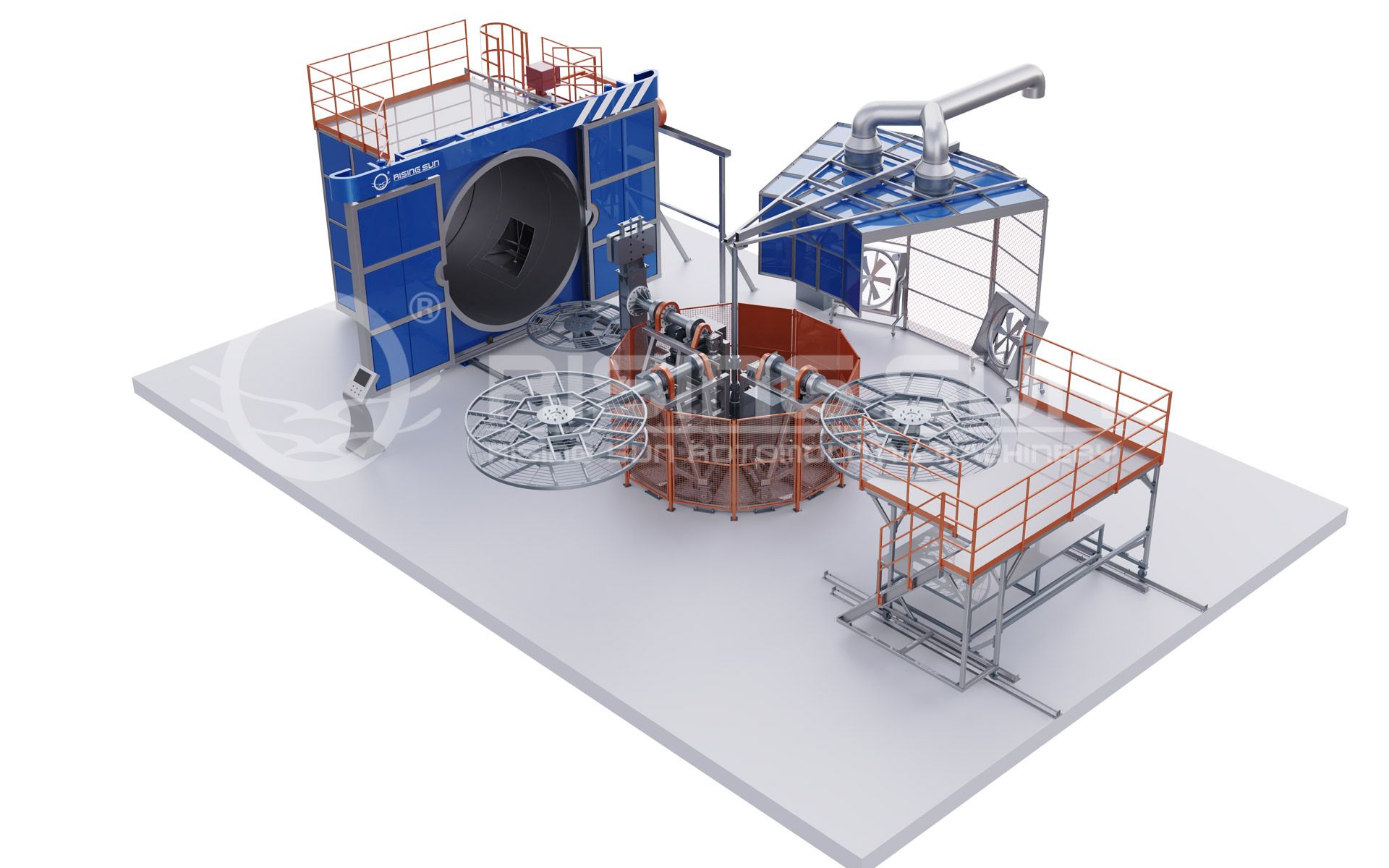
Swing radius rarely gets the attention it deserves until a carousel is sitting in a toolroom aisle, blocking a forklift path or clipping the corner of a workbench. Two units can share the same footprint on paper, yet one may need an extra eighteen inches of clear floor because its baskets travel through a wider arc. That difference usually comes from basket depth, off-center pivot placement, or the way the frame is counterbalanced. In a tight mold storage area, a model with a smaller swing radius can mean keeping a walkway open rather than forcing people to sidestep around a moving load.
Mold clearance numbers are just as telling, and they separate carousel models more honestly than catalog capacity ratings. The listed mold size might fit between the frame rails, but real molds carry eyebolts, water manifolds, ejector rods, and sometimes a slightly bowed safety strap. A carousel that clears a 24-by-36-inch mold may still reject a 24-by-36-inch mold with a hose fitting sticking out three inches on one side. The useful number is not the pocket width; it is the maximum working envelope when a mold is rotated into the storage position with all its awkward parts attached.
When comparing models, look past load rating and shelf count. One design may give you a larger swing radius but offer enough depth to store taller molds in the rear positions without scraping the frame. Another may feel compact but only works cleanly with shallow, square molds that have no protruding hardware. The most practical approach is to load the worst mold you own into the drawing, or into a test bay if possible, and measure the real clearance at the tightest point of rotation. That single number often does more to separate one carousel from another than any brochure spec.
Closed-Loop Temperature Control Without the Usual Maintenance Burden
Closed-loop temperature control earns its keep in environments where small thermal drift creates real problems. Instead of cycling a heater or chiller on a fixed schedule, the loop reads actual temperature, compares it against the target, and adjusts output continuously. That constant correction handles load changes, door openings, or shifts in ambient conditions without asking an operator to step in and reset a setpoint.
The maintenance side changes because the loop removes much of the mechanical punishment that wears systems down. There are no contactors chattering at every threshold, fewer electromechanical parts to pit or stick, and no routine recalibration needed just to keep the readings believable. Solid-state switching and automatic sensor diagnostics absorb most of the small failures that would otherwise turn into service calls.
What remains is a narrower control band and a much quieter maintenance schedule. The loop corrects for drift before it becomes visible in the process, so quality stays consistent while technicians spend time on actual problems rather than chasing a temperature swing. Over months of running, that combination tends to lower spare parts usage and reduce the number of planned shutdowns tied to thermal instability.
Cooling Airflow Patterns That Prevent Warp Before the Part Leaves the Station
Warp rarely shows up as a sudden failure at ejection. It begins in the last seconds of cooling, when thin ribs, deep bosses, and long sidewalls lose heat at different rates. The most useful airflow patterns are not designed to chill the entire part evenly. Instead, they aim a sharper, shorter pulse at thicker sections while giving slender edges a softer flow, pulling the thermal center toward the areas that can actually resist distortion. That imbalance sounds wrong, but it is often what keeps the part straight.
A moving diagonal curtain works better than fixed nozzles aimed straight into the cavity. It starts near the gate or the last-filled region and sweeps across the part in one pass, which avoids forming a cold skin over a still-hot core. When the outer layer freezes too early, the core continues shrinking underneath it and produces a bending moment that only becomes visible after the part leaves the station. Some lines also interrupt the air supply for a fraction of a second between bursts, letting surface heat migrate outward and breaking up the boundary layer that would otherwise insulate deep ribs and standing walls.
The most stable setups connect this airflow shift to a surface temperature trigger rather than a fixed timer. Once an infrared sensor sees the part fall below a set threshold, the flow drops from high-volume cooling to a lower, steadier movement that stays on until the fixture releases the part. That final minute matters more than total airflow capacity. A part can look straight as it leaves the station and then bow hours later because the core was still hot when the air stopped. Keeping the part under a controlled, moving pattern through the very end prevents much of that delayed warp.
Why Independent Arm Indexing Beats Fixed-Table Timing on Mixed Runs
Mixed runs punish any system that assumes every station finishes in the same number of seconds. Fixed-table timing locks all positions to a single rotary pulse, so a deep bore on one part and a light chamfer on the next are forced into the same window. The result is more air cutting, more waiting at the load station, and a rhythm that starts to drift as soon as tool wear changes a single operation by half a second.
Independent arm indexing breaks that coupling. Each arm can dwell, reverse, or advance based on the actual cut time at its own spindle, so the slow feature does not hold the fast one back. On mixed runs this matters even more because part geometry changes from cycle to cycle; the cell does not need a full re-time, only a parameter change for the affected arm.
There is also a less obvious benefit at changeover. With a fixed table, adjusting one station usually means disturbing the timing of the others to keep everything synchronized. Independent arms let you swap one fixture or probe routine while the rest of the cell keeps producing, which shortens the break between low-volume jobs and keeps scrap from creeping in during revalidation.
Consistent Part Weight Starts Before the Powder Hits the Mold
Part weight variation rarely shows up as a molding problem first. It starts much earlier, in the way powder is delivered, settled, and presented to the feed zone. Slight shifts in bulk density, moisture pickup, or particle size distribution can change how much material enters each cavity before pressure is ever applied. Once that happens, the press can only do so much to correct it.
Feed shoe movement, fill depth, and dwell time matter more than many operators assume. A shoe that moves inconsistently or pauses too briefly leaves some cavities short and others packed. Powder bridging near the shoe outlet is another quiet source of trouble: it may look like the shoe is full and functioning, but the material stops flowing the same way every cycle. Checking fill height at the shoe, not just final part weight, often reveals where the drift begins.
Stable part weight comes from making the powder behave the same way cycle after cycle. That means controlling incoming material condition, keeping feed surfaces clean, and verifying that fill time and shoe travel are repeatable. Small adjustments made before the powder reaches the mold are usually cheaper and more effective than chasing density or thickness later in the process.
FAQ
A carousel design keeps multiple arms rotating through fixed heating, cooling, and service stations, so one mold can be cooling while another is heating. This continuous cycling minimizes idle time and helps each part see nearly identical thermal history from cycle to cycle.
The main ones are arm speed control, oven temperature zoning, and the ratio of heating to cooling time. Machines with independent arm drives and tighter air circulation tend to produce more uniform walls because the mold rotates through the same temperature profile every pass.
They usually allow each arm to run its own cycle recipe. A four-arm or six-arm machine can have varied mold diameters and part weights loaded at once, while the control system tracks each arm separately and adjusts heating, cooling, and dwell times to match the mold.
Gas burner alignment, air duct cleanliness, and arm bearing wear are the three areas to watch. If any of these drift, the mold may not see the same airflow or rotation pattern, and that shows up as uneven wall thickness or warpage over time.
Models with larger swing diameters and higher payload ratings per arm tend to be preferred for big tanks and playground components. Independent temperature control across oven chambers and programmable arm indexing also help manage the longer heating and cooling curves these parts require.
Cooling needs to be as controlled as heating. Forced-air fans, optional water mist, and adjustable exhaust all affect how quickly the part solidifies. A carousel machine that lets you fine-tune cooling per arm reduces warping and shrinkage variation from one cycle to the next.
Look beyond the arm count and footprint. Compare the control interface, whether each arm can run a separate recipe, the burner and fan modulation range, and how easy it is to access the oven for cleaning. Real-world cycle repeatability usually comes down to those details rather than the nameplate size.
Conclusion
A four-arm carousel machine changes the math on cycle time mostly because heating, cooling, and loading happen in separate quadrants instead of waiting on a single station. The part releases at a more predictable temperature, and operators are not rushing to strip a mold while the next arm is already indexing into the oven. What separates one model from another in practice is rarely the rated swing radius alone; it is the clearance between the mold face and the frame at full rotation. A unit with an extra 150 mm of clearance can accept a deeper cavity or a taller insert without forcing the shop into a larger footprint. The better models pair that mechanical headroom with closed-loop temperature control that reads the mold surface directly. That removes the constant fiddling with thermocouples and burner settings, so the maintenance burden drops rather than shifting to the control cabinet.
Cooling airflow is where many machines either hold tolerance or quietly ruin it. Instead of blasting every side at the same rate, more precise models divide the cooling station into zones and taper fan speed as the part skin sets. That prevents the corners from cooling too fast and pulling the walls inward before ejection. On mixed runs, independent arm indexing makes a larger difference than fixed-table timing because a heavy part can dwell longer in the oven while a thin part moves ahead without stalling the whole cycle. Consistent final weight still depends on what happens before the powder reaches the mold. Machines with metered shot loading and controlled drop height distribute the material more evenly from the start, which reduces the need to compensate later with longer cook times or manual powder touch-ups.
Contact Us
Contact Person: Sharon Zhu
Email: [email protected]
Tel/WhatsApp: 8615712666272
Website: https://www.risingsunroto.com