
Warning Heat Transfer Labels Manufacturer: Expert Guide to Durable Safety Labels
2026-09-24
When a safety warning fades or peels away, the consequences can be serious—and costly. That’s why choosing the right heat transfer label manufacturer matters more than most engineers realize. In this expert guide, we break down what makes warning heat transfer labels truly durable, from adhesion strength to abrasion resistance, and why Victorygen heat transfer label has become a trusted name for labels that stay legible under harsh conditions. If you’ve ever wondered whether your safety labels can survive heat, chemicals, or repeated cleaning, keep reading—the answer might surprise you.
What Makes Heat Transfer Warning Labels Last in Harsh Conditions?
Durability in extreme environments rarely comes from a single clever material. It is almost always a combination of a dimensionally stable substrate, an ink system that cross-links under heat, and an adhesive that keeps working when thermal cycling tries to peel the label away from the surface. Polyimide and ceramic-filled polyester films tend to outperform standard vinyl because they do not shrink, embrittle, or lose legibility after repeated exposure to high temperatures. The ink itself has to bond chemically with the face stock, not just sit on top of it, otherwise solvents, oils, and abrasion will gradually erase the warning message.
Surface preparation and finishing often matter as much as the label construction. A rough or textured housing reduces the actual contact area, so a thicker, softer adhesive layer is needed to flow into micro-grooves and maintain grip. In many production lines, a clear UV-cured overlaminate is added after printing. That layer takes the brunt of scuffs, chemical splashes, and UV exposure, preserving the printed graphics underneath. The overlaminate also helps prevent edge lifting, which is a common failure point when labels are applied to curved or constantly vibrating equipment.
Real-world performance depends on testing that mimics the worst conditions the label will face, not just a clean lab bench. Thermal shock cycling, salt fog exposure, and Taber abrasion tests can reveal weak bonds and ink adhesion problems early. But some of the most useful data comes from long-term field trials on outdoor machinery, where sunlight, rain, and temperature swings interact in ways no single accelerated test can fully replicate. Labels that survive those conditions for several years without fading or peeling are the ones that prove the material and process choices were right.
Choosing the Right Materials for Durable Safety Label Performance
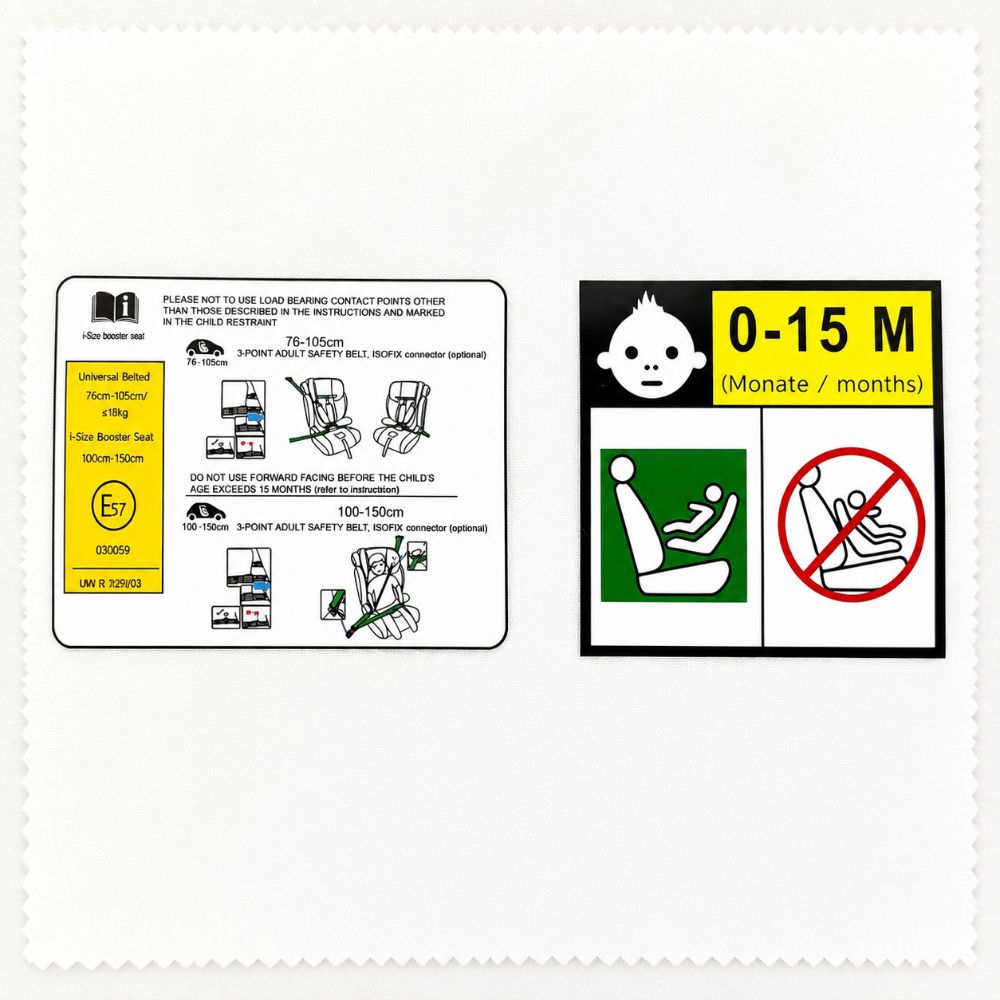
The longevity of a safety label is decided long before it reaches the production floor. Start with the surface it adheres to: powder-coated metal, textured plastic, and rough castings each demand different adhesive chemistries. A high-tack acrylic adhesive works well on low-surface-energy plastics, while a rubber-based adhesive often grips better on powder coats and lightly oiled metals. Overlooking this matching step leads to edge lifting and peeling within weeks, especially in washdown areas or outdoor yards where temperature swings are constant.
Face material is equally critical. Polyester films hold up against chemicals, abrasion, and UV exposure far better than vinyl or paper, making them the default choice for arc flash warnings, lockout tags, and equipment nameplates. For labels exposed to frequent contact or cleaning solvents, add a UV-stabilized overlaminate rather than relying on the printed surface alone. In cold-storage or marine environments, choose a label with a lower service temperature rating, otherwise the film can become brittle and crack along its edges. Testing a small batch on the actual substrate for two to four weeks remains the most reliable way to catch material mismatches before a full rollout.
Custom Warning Heat Transfers That Withstand Extreme Temperatures
When a warning label has to survive next to a furnace exhaust or on equipment left outside in a northern winter, standard heat transfers fail fast. These custom transfers use a cross-linking ink system and a high-temperature adhesive that won't turn brittle when the mercury drops or soften and smear under sustained heat. You get sharp, legible safety markings that stay put through thermal cycling that would curl and crack ordinary decals.
The real difference is in the cure. After application, the ink bonds into the substrate instead of just sitting on top of it. That means the warning text, pictograms, or barcode data resist abrasion, solvents, and repeated exposure from -40°F up to 600°F, depending on the material pairing. We've run samples through hundreds of rapid temperature swings and still found the adhesion and print contrast intact.
Because these are made to order, you're not stuck with a generic size or color palette. Red, orange, yellow, or high-visibility black-on-yellow can be matched to your existing safety scheme, and the artwork can include fine-line detail that stays readable after years in the field. For heavy equipment, industrial ovens, or outdoor power units, the result is a warning that works as hard as the machine it's mounted on.
Application Methods to Extend the Life of Safety Labels
Before affixing any safety label, wipe the mounting surface with a lint-free cloth dampened with isopropyl alcohol or a mild solvent. This step removes oils, dust, and residual adhesives that quietly undermine bond strength. On textured or powder-coated metal, a quick scuff with fine sandpaper gives the adhesive more bite without leaving visible marks.
Use a hard rubber roller or the back of a plastic squeegee to press the label from center outward. Focus extra pressure along the edges, where peeling tends to start. Avoid dragging your fingers across the face—this can introduce skin oils and create uneven contact. For labels applied outdoors, consider sealing the perimeter with a thin bead of clear silicone or edge sealant after the initial bond has set.
In high-abrasion or chemical-washdown areas, apply a clear overlaminate film cut slightly larger than the label. This sacrificial layer takes the beating from scuffs, solvents, and UV exposure. Inspect labels during routine maintenance walks and replace the overlaminate before it becomes cloudy or cracked. If corners begin to lift, clean the area and re-secure them promptly rather than waiting for full delamination.
Meeting Industry Standards for Long-Lasting Warning Labels
Warning labels that hold up in demanding environments share a quiet insistence: they remain legible long after lesser markings have faded into ghostly smudges. Meeting industry standards here is not merely about ticking a compliance box. It means selecting face stocks and adhesives engineered for the specific stresses each surface will face, whether that's chemical splash, UV exposure, abrasion, or extreme temperature swings. A label that curls, cracks, or loses its color contrast within months fails both the user and the safety protocol it was meant to support.
The most reliable long-lasting warning labels are built around recognized performance benchmarks, including those for print permanence, adhesion strength, and resistance to solvents. Polyester and polycarbonate substrates often outperform vinyl when labels must survive repeated cleaning or outdoor weathering. Paired with UV-cured inks or thermal transfer printing, these materials keep critical hazard text and pictograms crisp enough to be read at a glance. However, standards compliance also demands validation: accelerated aging tests, cross-cut adhesion checks, and real-world pilot placements reveal whether a label will still earn its place after years of service.
Durability alone is not enough if the label cannot be applied consistently in production. Meeting industry standards means the label system—material, adhesive, and print method—must work with the realities of the assembly line or maintenance workflow. Whether applied by hand, automatic dispenser, or in-mold process, the chosen construction should resist edge lifting, bubbling, and chemical degradation at the point of contact. When procurement and engineering teams align on tested, application-specific solutions, safety communication remains intact well beyond the warranty period, reducing the need for costly re-labeling and preventing avoidable workplace incidents.
Key Questions to Ask a Heat Transfer Label Manufacturer
Before you sign off on a supplier, ask what substrates their heat transfer labels actually stick to. Polyester, nylon, cotton blends—each behaves differently under heat, and a manufacturer that doesn't ask about your end product early on may be guessing. Request real test data for wash fastness and abrasion, not just a generic spec sheet.
Order minimums and art preparation are where hidden friction shows up. Ask whether they'll run a small pilot batch before you commit to thousands of units, and whether setup charges apply per design or per color. If color accuracy matters, ask how they match Pantone references and what variance they consider acceptable. Also clarify file formats—some shops only work with AI or EPS files, not high-res PDFs.
Finally, pin down turnaround times, rush fees, and what happens when a batch arrives with defects. A good manufacturer will send pre-production samples for your approval and stand behind their work with a clear replacement policy. Ask for references from brands with similar product lines, and don't skip questions about chemical resistance if your labels will face sunscreens, oils, or industrial washing.
FAQ
The lifespan depends on the label substrate, the resin used for the transfer, and the adhesive's resistance to temperature swings, chemical exposure, and abrasion. Polyester-based transfers tend to hold up better than vinyl in outdoor settings, especially when a UV-stable topcoat is applied during manufacturing.
Yes, but only if the manufacturer formulates the print layer and protective laminate specifically for chemical resistance. Standard heat transfers may fade or peel when exposed to MEK, acetone, or hydraulic fluid. Ask for a chemical resistance chart and request samples that have been immersion-tested for at least 72 hours in the specific fluids your equipment encounters.
Most durable safety labels are applied using a heated silicone roller or a flat heat press. The surface must be clean, dry, and preheated to remove moisture. The transfer is positioned, then pressed at a controlled temperature, usually between 150°C and 180°C, for 10 to 30 seconds depending on the material thickness. After cooling, the carrier film is peeled away, leaving the graphic fused to the substrate.
They use UV-cured inks or add a clear UV-blocking laminate over the printed layer. Pigments should be lightfast and not based on dyes that migrate. A quality manufacturer will run accelerated weathering tests equivalent to 5 to 10 years of outdoor exposure and check for color shift, gloss loss, and legibility of small text.
Powder-coated metal, rigid plastics like ABS or polycarbonate, and some fiberglass composites accept heat transfers well. Porous or low-energy surfaces such as untreated polyethylene or rough-cast aluminum often require a primer or adhesive promoter. The manufacturer should verify surface energy is above 38 dynes/cm for reliable bonding.
Absolutely. Heat transfer printing can reproduce Pantone colors, fine line work, and machine-readable codes if the label area is large enough. Barcodes and QR codes need a minimum quiet zone and a matte finish to reduce glare. Ask the manufacturer to provide a digital proof and a short-run sample before committing to full production.
Look for compliance with ANSI Z535 for safety sign design, UL 969 for labeling and marking systems, and ASTM G154 for UV weathering. For chemical resistance, ASTM D896 or similar immersion tests are useful. A serious manufacturer will share test reports and explain how their materials perform under real-world conditions rather than just listing standards on a brochure.
Remove all grease, silicone, and oxidation with an isopropyl alcohol wipe or a mild solvent recommended by the label supplier. Lightly abrading smooth or glossy surfaces with a fine Scotch-Brite pad can improve mechanical bonding, but this must not damage any protective coating. After cleaning, avoid touching the area with bare hands, and apply the transfer within a few minutes to prevent dust or moisture from settling back on the surface.
Conclusion
Durability in warning heat transfer labels comes down to a mix of smart material choices and proven application techniques. Manufacturers that prioritize rugged face stocks, aggressive adhesives, and UV-resistant top coats are the ones whose labels survive abrasion, chemical splash, and years of direct sunlight. Rather than relying on a single miracle substrate, the best suppliers match polyester, vinyl, or specialized polyimide films to the exact environment—whether that means engine bays, outdoor equipment, or washdown areas. Equally important is how the label is applied: consistent heat, pressure, and dwell time during transfer prevent edge lifting and premature fading. Skipping these fundamentals is why many "durable" labels fail within months, while properly engineered heat transfers stay legible for a decade or more.
Beyond the physical product, a trustworthy manufacturer should prove compliance with ANSI, ISO, or OSHA warning label standards without making you ask twice. Look for partners who offer accelerated aging data, real-world field samples, and clear guidance on surface preparation. Ask pointed questions about adhesive peel strength, temperature cycling tolerance, and whether their inks resist common solvents. The goal isn't just a label that looks sharp on day one—it's a safety communication tool that remains readable after years of abuse. When you find a supplier who treats warning labels as engineered components rather than commodity stickers, you've found a partner worth keeping.
Contact Us
Contact Person: Wang Song Lin
Email: [email protected]
Tel/WhatsApp: +8613751282193
Website: https://www.heat-transferprinting.com/