
What Is China Tactile Paving and How Does It Guide Pedestrians?
2026-08-30
Next time you walk through a bustling Chinese city, pay attention to the ground beneath your feet. Those raised bumps and ridges aren't just decoration—they're a silent language guiding millions of pedestrians every day. Known as tactile paving, this system helps people with visual impairments navigate streets, transit hubs, and public spaces with surprising precision. But how exactly does it work, and why has China made it such a visible part of urban design? From directional bars to warning domes, each texture has a specific job. And as cities evolve, manufacturers like Beata Ceramics are pushing the materials forward without losing the practical soul of these ground-level guides. Let's step onto the path and read the stories written in texture.
Not Just Decoration: The Real Job of Those Yellow Strips
Most people step on them without a second thought, but those bright yellow strips with raised bumps aren't there to make the ground look tidy. They're a tactile warning system, designed to be felt through shoes or a cane before a visually impaired person reaches a danger zone like a train platform edge or a flight of stairs. The color is also deliberate: the high contrast makes them easier to spot for those with some remaining vision.
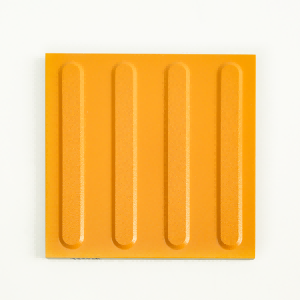
Each pattern carries a message. Rows of dots often signal a hazard directly ahead—stop and reassess. Long bars, on the other hand, indicate a safe direction of travel, like along a crosswalk or toward a ticket gate. Without these strips, many public spaces would turn into guessing games for people who rely on sound and touch rather than sight.
Reading the Ground: How Feet Interpret Texture
The soles of the feet are packed with mechanoreceptors that translate pressure, vibration, and shear into nerve impulses. When you step from pavement onto gravel, Pacinian corpuscles fire in rapid bursts to signal the sudden shift in surface irregularity, while Merkel cells keep a steadier stream of information about sustained contact. This isn’t a passive readout—the brain actively compares these signals with the previous step, adjusting muscle tension in the ankle and arch before you consciously register that the ground has changed.
Texture is decoded not as a single sensation but as a pattern across time. A cracked sidewalk produces low-frequency pressure waves that mainly engage slow-adapting receptors, telling the body to widen its base of support. In contrast, fine sand or loose soil creates shifting, unpredictable contact points that demand constant micro-adjustments from the intrinsic foot muscles. The brain blends this tactile data with memory of similar surfaces, so a familiar trail feels instantly “readable” while a new texture forces a brief but noticeable recalibration of gait.
This sensory channel is most vivid when the foot is unshod or in minimal footwear, because thick soles dampen the very vibrations and pressure gradients that carry useful information. A barefoot walk over moss, warm rock, or cool tile reveals how much nuance the foot can capture—each step is a negotiation between grip, give, and slipperiness. When that feedback is muted, whether by stiff shoes or age-related nerve loss, balance and reaction time suffer, underscoring just how deeply movement depends on the foot’s quiet conversation with the ground.
From Station Platforms to Sidewalk Crossings
The moment you step off a train, your feet register the change before your eyes do. Platform paving gives way to a grooved warning strip, then to the slight downhill slope of a ramp or the first stair tread. Fluorescent lighting fades behind you, replaced by whatever the sky happens to offer. These few seconds contain dozens of small decisions — how fast to walk, which side to pass on, whether to pause for a family struggling with a stroller.
Crossing a street after leaving the station is rarely as simple as waiting for a green light. Curb cuts might be missing or blocked by parked delivery vans. The push-button for the pedestrian signal may be positioned awkwardly for someone using a wheelchair. The countdown timer might give you twelve seconds to cross six lanes, or thirty seconds to cross two. For anyone carrying luggage, pushing a cart, or guiding a child, those numbers shape the entire rhythm of the trip.
What happens between the platform and the far curb often decides whether a journey feels effortless or exhausting. The best station areas treat that transition as a single continuous surface — one where the gap between train and platform, the slope of the ramp, and the timing of the crosswalk are designed together, not as separate afterthoughts. When they are not, you feel every missing inch of curb and every extra second of signal delay.
The Two Patterns That Tell You Stop or Go
Most people look for a single, dramatic sign before deciding to push forward or pull back. That rarely works. What actually separates smooth execution from costly stalls comes down to two recurring patterns. The first shows up when small efforts keep producing useful feedback—each attempt teaches you something concrete, resources keep lining up without excessive force, and the next step feels obvious even if the path ahead isn't fully mapped. That's your signal to keep moving.
The second pattern is less obvious because it hides inside reasonable-sounding delays. You find yourself re-explaining the same problem, waiting on the same missing input, or watching early gains fade into repeated rework. Energy stays high but forward motion flattens. When three separate attempts produce the same unresolved friction, that's not a test of persistence—it's a stop sign wearing a disguise.
What makes these patterns reliable is that they don't depend on mood, confidence, or even skill. They show up in the work itself. If you start tracking what happens after each small move, the go pattern and the stop pattern become hard to confuse. Push when the loop gives back more than it costs. Pause when it starts taking more than it returns. That's the whole read.
Why China’s Cities Rely on This Quiet Guide
In the dense lattice of Chinese urban life, where millions move in coordinated silence, a peculiar kind of expertise has become indispensable. It does not announce itself through loudspeakers or flashy apps, yet it shapes the flow of daily existence. This quiet guide is not a person, but a layered system of subtle cues—hand-drawn maps taped to subway pillars, elderly volunteers who stand at confusing intersections, and the unspoken agreement that certain stairwells are for ascending only. Together, they form an informal operating manual that keeps the city from descending into chaos.
What makes this guide so reliable is its invisibility. Visitors often miss it entirely, mistaking the smooth movement of crowds for natural order. But residents know better: the slight tilt of a sign written in fading ink, the practiced wave of a parking attendant who has memorized every license plate on the block, the way a street vendor rearranges stools to signal an incoming delivery. These are not random acts of helpfulness; they are the accumulated wisdom of a community that has learned to communicate without noise.
As Chinese cities grow taller and more complex, the need for such guidance only deepens. High-tech navigation fails in the narrow alleys where GPS signals bounce off concrete walls, and automated announcements blur into background static. It is then that people turn to the quiet guide—the neighbor who points out the shortcut through a courtyard, the shopkeeper who warns of a staircase closed for repairs. In a world that increasingly shouts for attention, China's urban dwellers continue to place their trust in the softest, most dependable voice of all: the one that requires no battery and never asks for a five-star rating.
A Simple Invention That Reduces Daily Risk
Most people don't think twice about the little wedge of rubber or wood that keeps a door from swinging shut. It sits on the floor, half-hidden by the door's shadow, and does its job without batteries, updates, or even a second thought.
That wedge removes a surprisingly common daily risk: the slammed door. A sudden gust of wind, a child chasing a pet, or a heavy fire door easing off its latch can all turn an ordinary doorway into a finger-pinching, tail-catching hazard. Slide the wedge under the edge, and the door stays put—open just enough for air and conversation, but still private enough for a bedroom or office.
Unlike smart locks or sensor alarms, this simple tool never needs recharging and rarely breaks. It works in a power outage and doesn't care whether your Wi-Fi is up. Sometimes the most effective safety device is the one you forget is there until it spares you a loud yelp and a bruised knuckle.
FAQ
Tactile paving is a system of textured ground surface indicators that people with visual impairments can feel underfoot or with a cane. The concept originated in Japan in the 1960s and has since been adopted worldwide, with each country adapting the patterns and colors to its own urban environment.
In China, tactile paving is almost always bright yellow, which makes it highly visible to people with low vision. This is somewhat different from places like the United Kingdom or the United States, where the color often blends with the sidewalk but the profile is raised more subtly. Chinese installations also tend to cover long continuous stretches rather than just isolated hazard points.
The two primary patterns are raised parallel bars and raised domes. Bars indicate a safe direction of travel and are laid along the path a pedestrian should follow. Domes, sometimes called warning studs, signal a change in the environment—such as a curb ramp, staircase, platform edge, or crossing point—and tell the person to stop or proceed with caution.
A person using a white cane will feel the continuous vibration of the parallel bars under the tip, which lets them know they are still on the intended path. When the texture changes to domes, the cane movement becomes bumpier and the sensation is distinct enough to act as an alert. Some pedestrians with residual vision also use the yellow color as a visual guide, while those who wear thin-soled shoes can feel the difference through their feet.
You will typically see them on sidewalks along major streets, around subway entrances, at bus stops, near crosswalks, and inside public buildings such as hospitals, libraries, and government service centers. In newer districts, the paths often connect residential compounds to transit hubs, forming a fairly continuous network rather than scattered patches.
Despite widespread installation, the paths are often blocked by parked bikes, scooters, street vendors, or utility poles. In some older neighborhoods the paving is discontinuous, leading to sudden dead ends or routes that direct pedestrians into obstacles. There is also variation in construction quality, where poorly installed tiles can crack, become slippery in the rain, or be laid too close to walls and fences to be useful.
Many sighted pedestrians do not pay much attention to them, but they often avoid standing on the yellow strips out of habit or respect. Cyclists and delivery riders, however, sometimes treat the smooth continuous path as a convenient lane, which creates conflicts. In busy commercial areas, the tactile surface can become a de facto queueing line for shops or food stalls, reducing its effectiveness.
Newer projects tend to use better-quality materials that resist wear and maintain slip resistance. Planners are more careful about routing paths away from obstacles and integrating them with curb cuts and crossing signals. Some cities are experimenting with contrasting colors at intersections and using slightly different textures for transit platform edges, aiming to make the environment clearer for all pedestrians while preserving the standard national guidelines.
Conclusion
Those raised yellow lines underfoot are easy to ignore—until you rely on them. In China, tactile paving is a purposeful network of textured ground tiles, not just visual decoration. The strips use two core patterns: rows of domes signal a hazard or stopping point, while long parallel bars trace a safe walking path. Underfoot texture becomes a language, read through shoe soles or a cane. This makes the ground itself a guide, quietly telling pedestrians when to pause at a crossing or follow a route through a busy station.
You’ll find these tactile cues from subway platform edges to sidewalk crossings, where they form a consistent, low-maintenance safety layer. Chinese cities depend on them because they work in noise, crowds, and poor lighting—no audio or visual cue required. It’s a simple invention: molded concrete or stone with raised bumps and ridges. Yet it sharply reduces daily risk for blind and low-vision pedestrians, while also helping distracted walkers notice changes. In a dense urban environment, that silent signal underfoot matters more than most people realize.
Contact Us
Contact Person: Emma
Email: [email protected]
Tel/WhatsApp: 8618064423698
Website: https://www.beataceramics.com/